
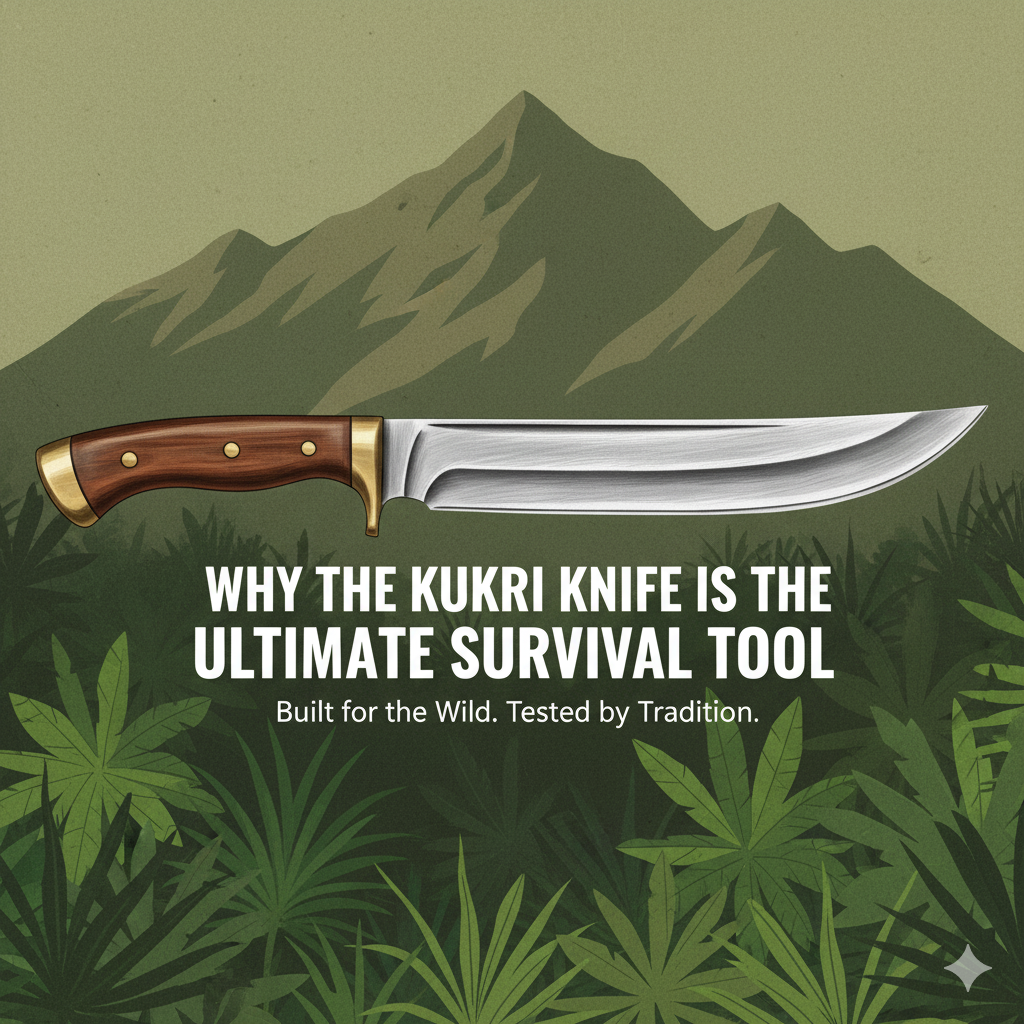
Few tools are as essential as a reliable knife when it comes to survival. In the woods, setting up a campsite, or facing a surprise wilderness scenario, our knife is often our best friend.
The kukri knife, or khukuri, has proven to be one of the best survival tools ever made. With its distinctive curved blade, functionality, and history, the kukri, or Nepalese blade, has become known around the globe—not only for its ancestral weaponry but also for its reliability and adaptation.
So, is a knife the most important survival tool? Yes, it is. And very few knives can compete with the kukri knife for survival use. Let’s talk about why.
History and Origin of the Kukri Knife
The kukri knife originated in Nepal, where the kukri has been viewed as a cultural symbol for many centuries. This knife was originally designed for Gurkhas, Nepal’s distinguished soldiers, who wore it themselves as a hand weapon and an efficient utility tool. The kukri’s curved blade design made it cutting-edge for use in their purposes of cutting wood, clearing brush, and even cooking while in the difficult Himalayan environment.
Over the years, the kukri evolved from a traditional weapon to, now, a widely admired and trusted survival tool. Through the military history of Gurkha soldiers, the kukri was carried by Gurkha soldiers in both World Wars, giving the kukri a notoriety for cutting power and strength.
Today, the kukri still exists between tradition and need, a representation of fine workmanship and food for the community.
Understanding the Structure of a Kukri Knife
The distinguishing feature of the kukri knife is its curved blade (often called a curve blade knife), which bends forward and centres the power at the tip. This unique design has the advantage of providing deeper cuts and better chopping with less effort.
Specifically, a traditional khukuri blade consists of:
Blade: Wide and curved, ideal for chopping, slicing, and cutting.
Spine: Thick and rugged, provides structural strength.
Handle: Wood, horn, or other modern composites, engineered for a solid grip.
Notch (Cho): A small notch on the base of the blade not only serves a symbolic purpose but is also functional, withholding blood from running down the handle.
There are many different khukuri blades for different uses, some for ceremonial use, others for military or survival use, or even camping use.
Why the Kukri Knife is Perfect for Survival
Following are the reasons kukris are best for survival:

Versatility in the Wild
Few knives can match the kukri for versatility in completing multiple survival tasks. Whether chopping some firewood, slicing through thick foliage, or preparing your food, the design of the kukri knife has built-in versatility for nearly all situations. A kukri can even be used for self-defence if an emergency arises.
Compared to straight survival knives, with the kukri knife’s forward-curved geometry, you will work smarter, not harder; it allows you to perform more powerful cuts with much less effort expended.
Strength and Durability
Made from high-carbon or tempered steel, you can expect high-quality kukris to be extremely tough. Durable with thick spine construction and made from a single solid tang design, you will have a knife that is not easily broken and very dependable in rough circumstances.
Ease of Use
Although its looks are bold, a kukri is very well-balanced. The handle of a kukri is designed to fit with the blade weight and is very ergonomic. For a new user, a kukri is remarkably simple and easy to use, with more control and greater precision compared to many straight-edge knives.
Also Explore: origin of khukuri kukri
Key Attributes to Look for in the Best Kukri Knife
When you’re looking for the best kukri knife available, here are some key features to be aware of:
Blade Material: High-carbon or stainless steel are generally good choices for strength and edge retention.
Sharpness: A consistently sharp edge is very important, as it will primarily be slicing and chopping.
Handle Comfort: An ergonomic handle prevents slipping while also reducing fatigue.
Weight & Balance: The more weight that is evenly distributed helps you to control and manoeuvre the blade with greater ease.
Sheath Quality: Leather or Kydex/Kraton sheaths provide safe storage for the knife and easy access.
EEAT Tip: Verify that the seller is an authentic seller or an established brand that manufactures in Nepal.
Selecting the Right Kukri Knife for You
Your best khukuri varies depending on what you intend to do with it. Consider these features:
Size: Smaller kukris are suitable for utility usage, while larger ones are better suited for chopping and heavier-duty needs.
Weight: Kukris that are lightweight to carry and control, while the heavier alternatives offer more impact.
Purpose: You have ceremonial kukris, survival kukris, and tactical kukris.
| Type | Blade Length | Weight | Purpose |
| Mini Kukri | 8–10 inches | Light | Camping & light work |
| Standard Kukri | 10–13 inches | Medium | Survival, hunting |
| Heavy Kukri | 13+ inches | Heavy | Tactical, chopping |
So which kukri is the best one? For the majority of survivalists, a standard-size khukuri made out of high-carbon steel is the best all-around balance of performance and control.
For a standard-size survival kukri in 5160 steel, look at the M43, the Angkhola or the mid-weight Limbuwan, or browse the full military series.
Well-Known Survival Experts & Their Kukri Knives
The most iconic and historical users of the kukri are the Gurkha soldiers, who have a reputation for using (or maybe not using) the knife with great skill and willingness. The kukri knife is still held in high esteem by modern survival experts, outdoor adventurers, teams and students on expeditions.
Famous adventurers and cutlery hobbyists, like Chris Caine and Bear Grylls, have referred to the kukri’s amazing structure for chopping capabilities and ease of handling in survival situations.
EEAT Tip: Look through military museums, Gurkha collections, or interviews with cutlery experts for authenticity.
How to Care for Your Kukri Knife
Caring for your Khukuri blade is relatively simple, and the ultimate aim is to enjoy it for a lifetime of use!
Cleaning: After every use, wipe down to avoid corrosion.
Sharpening: Use a sharpening stone or chakmak (traditional sharpening tool).
Oiling: Once a year, or whenever you use your khukuri, apply a thin coat of oil on the steel.
Storage: Keep in a dry sheath and avoid the combination of moisture and the sheath.
Finally, avoid hitting stones or extremely hard metals to maintain the overall integrity of the edge.
Practical Survival Situations for Kukri
In the woods: animal path clearing, tree branch chopping, and building shelter.
Of an emergency: food preparation, first aid, or defending yourself.
When camping: preparing fire, processing wood, and food preparation.
Tactical use: A reliable cutting edge in tactical defence or rescue situations.
The combinations of strength and precision make it a true all-around survival tool.
Where to buy the best Kukri knife
Find the best kukri knife for sale from a real, reputable source—preferably a place that works directly with Nepalese craftsmen. You can also depend on trustworthy online sites and knife-specific retailers with high reliability ratings that provide detailed specifications, reviews, and guaranteed authenticity.
When buying, consider:
- Authentic materials
- Hand-forged
- Warranty or certificate of authenticity
Frequently Asked Questions (FAQs)
Q1. Is a knife the most essential tool for survival?
Yes, and the kukri knife is unique in that it is both extremely versatile and strong.
Q2. Who is the greatest Kukri Knife survivalist of all time?
The Gurkhas serve as the greatest all-time example of mastery of the kukri, due to their unprecedented bravery.
Q3. Which kukri is the best?
A medium-sized kukri made of high-carbon steel works well in most survival and outdoor situations.
Q4. How do I sharpen a khukuri blade?
You can use a fine-grit whetstone or chakmak while following the original angle of the blade.
Q5. Can a kukri knife be used for hunting and chopping wood?
Yes, a kukri’s curved blade design is tailored for tasks of precision and power.
Conclusion
The kukri knife has come a long way from its early roots in Nepal. Today, enthusiasts and survivalists regard it as the ultimate survival knife for any situation. Its versatility, toughness, and ergonomics are comparable to no other knife in the wilderness.
You’re probably searching for the best kukri for sale, or you simply want to learn about the heritage behind the khukuri. Either way, you understand that this curved blade is an extension of yourself—the trusty knife is a true survival knife in every sense, with a legacy that will survive for generations.