
Which Is Better: Kukri or Bolo Machete?
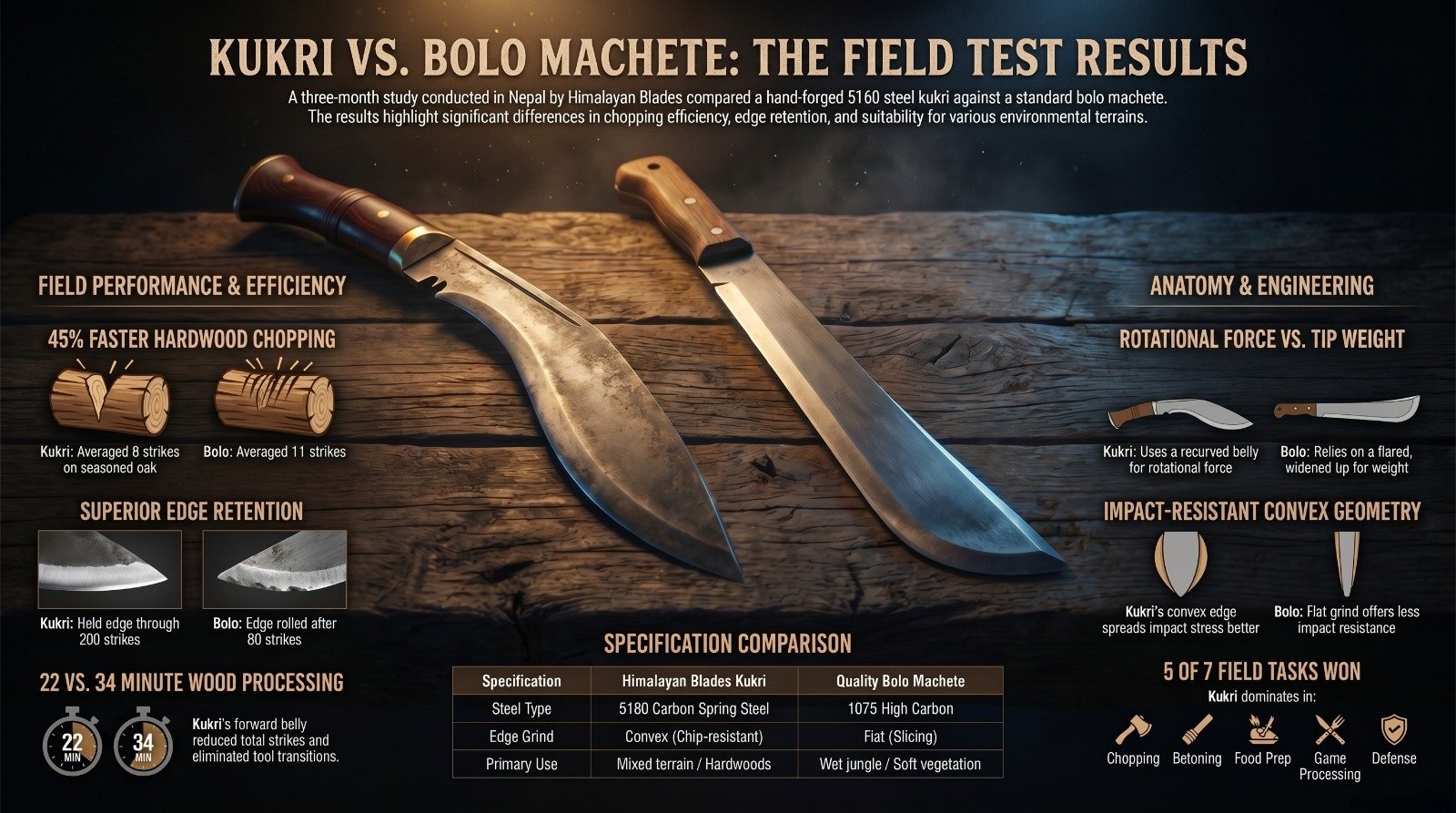
The kukri vs bolo machete contention is more complex than other blade comparisons. Since both feature forward-weighted designs, many customers perceive similar functionality. However, after three months of side-by-side experimentation in our workshop in Nepal, we noted differences in performance for hardwood chopping, edge retention, and a host of other camp tasks.
The aim of this guide is to present the data we compiled during our experiments, so you can make an informed decision and avoid purchasing the inferior blade. Visit our primary kukri vs machete guide at HimalayanBlades.com for the complete analysis. Specifically, it covers aspects of steel, physics, and the role of each blade design in survival. This article specifically deep dives into a kukri vs bolo, but I would recommend to check out how kukri vs machete (in general) perform.
Check out our best-selling fuller kukri
-
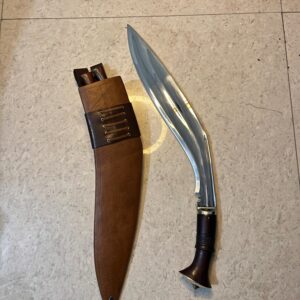
Great War Dui Chira Khukri
$179.00 -
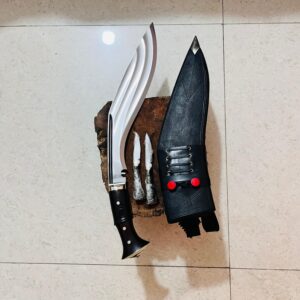
Tin Chira Khukuri
$195.00
Kukri vs Bolo Machete: Summary
| Hardwood chopping (average strikes) | Kukri: 6 strikes | Bolo: 11 strikes |
| Edge retention (after 200 strikes) | Kukri: holds edge | Bolo: rolls after 80 |
| Best machete for cutting green vegetation | Bolo Machete |
| Best one-tool for mixed terrain | Kukri (dominates 6 of 7 tasks better than Bolo) |
| Steel Quality at Himalayan Blades | 5160 spring steel, 52-56 HRC edge, double temper |
| Internal Comparison | kukri knife vs machete guide (himalayanblades.com) |
Kukri vs Bolo Machete: Blade Anatomy Compared
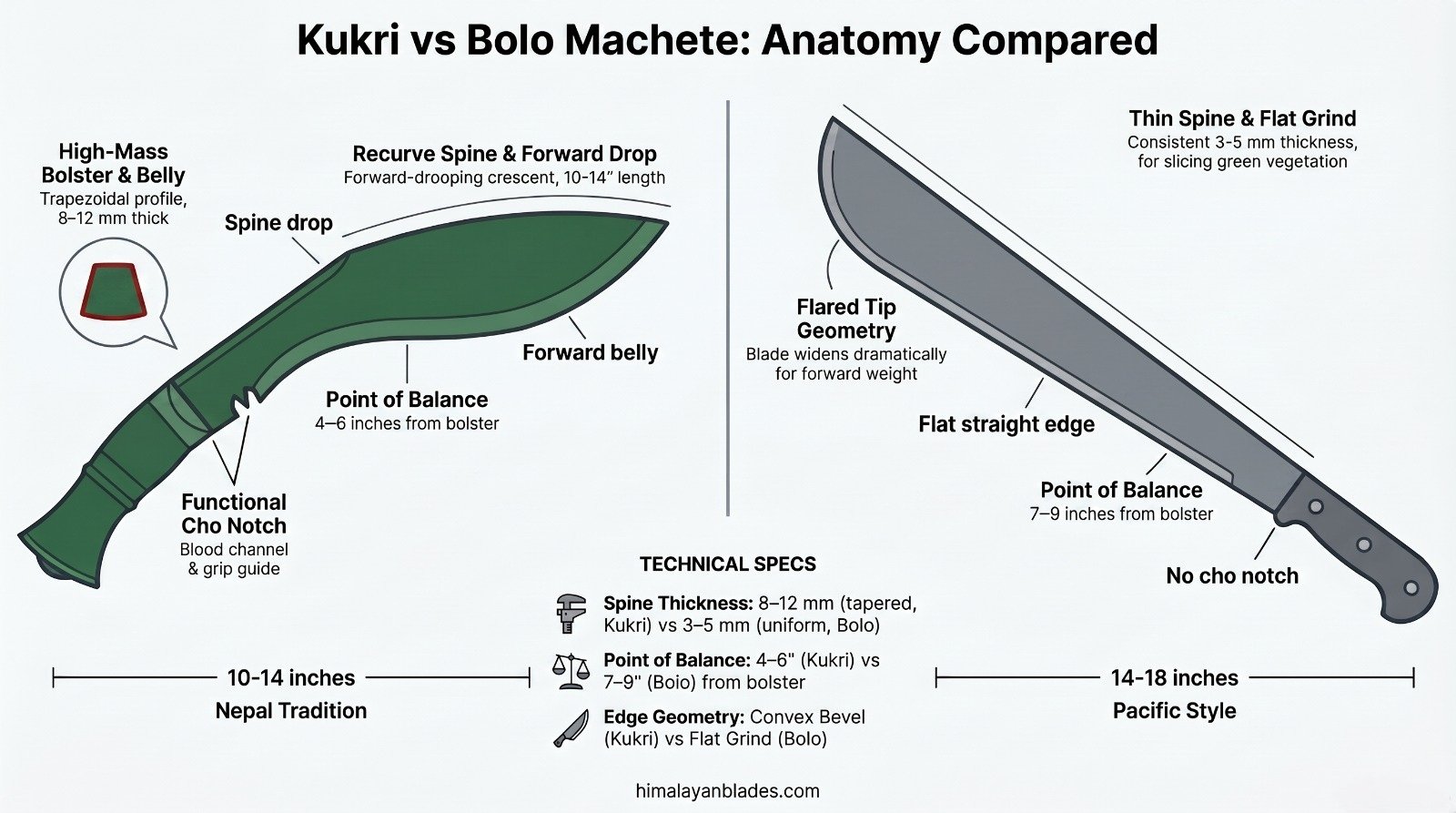
The kukri blade has a bend forward.
Near the middle of the kukri blade, the blade spine dips downward at an angle, producing the recurve. The kukri belly measures 5 mm at the spine groove and increases to 8-12 mm at the bolster. Also, the cutout notch (cho notch) at the base of the blade serves as both a blood channel and a grip guide.
The bolo machete also has a forward center of gravity. Here, the bolo achieves a forward center of gravity through a widened tip and not a recurved belly. Unlike the kukri with a thick spine, the bolo’s spine runs only 3 to 5 mm, so it lacks the kukri’s structural mass. The bolo also uses a flat grind, while the kukri employs a convex bevel. Additionally, this difference affects edge life on hard materials.
Kukri vs Bolo Machete: A Brief History of Both Blades
The Kukri: Over 1,400 Years of Documented Service
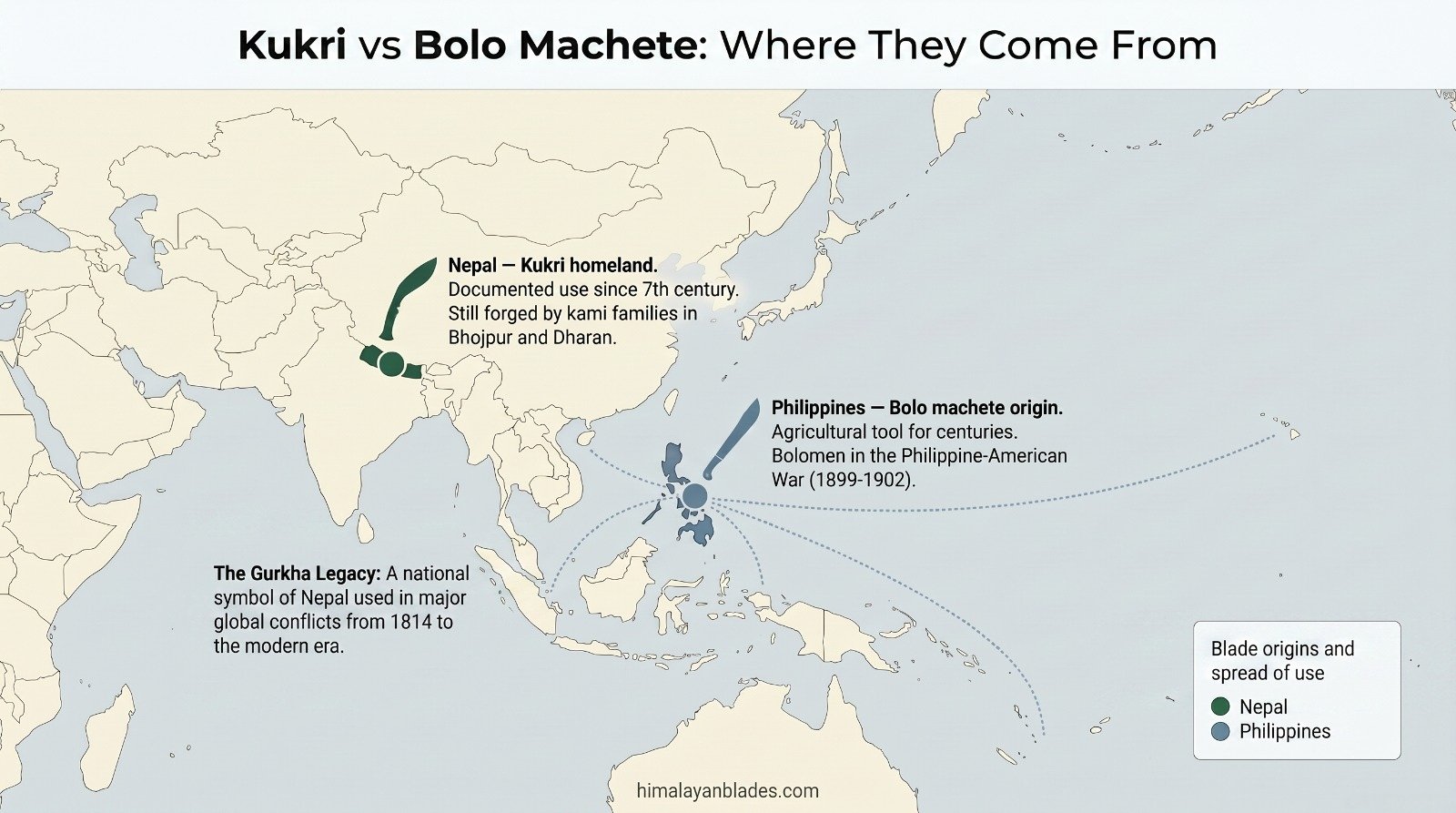
The authentic khukuri of Nepal dates back to the 7th century in the Gorkha Kingdom of Nepal, with early documented examples in the 7th century. Gurkha soldiers used it in the Anglo-Nepalese War (1814-1816), both World Wars, the Falklands War (1982), and the Kargil War (1999). For 14 centuries, no other short blade has served in the capacity of a military sidearm and a household tool, as the kukri has.
Today, the kukri continues to serve the Gurkha Brigade and represents a symbol of the Nepal nation. The blade also earns a reputation that no factory product can replicate, as it serves in the battlefield and kitchen.
For more details on the Gurkha service record and Victoria Cross citations, see our kukri vs machete guide at HimalayanBlades.com. It includes full documentation of kukri use in combat.
The Bolo Machete: From the Battle Fields of the Philippines to Survival Kits
The bolo machete originated in the Philippines, where farmers used it to harvest crops long before Europeans arrived. Bolo is a Tagalog term that means the tool’s blade is widened at the tip. Maldonado’s (2008) Dictionary of Martial Arts describes these fighters as bolomen. They primarily employed the bolo during the Philippine-American War (1899-1902).
The bolo machete then became a common agricultural and survival tool in the rest of the Pacific Islands, Hawaii, and Southeast Asia. In the US, survivalists and bushcrafters know the bolo machete as a replacement for a standard machete. Its weighted tip allows a more powerful swing. The weighted tip of the bolo machete does not match the kukri’s efficiency in chopping through hardwood, as the following results will show.
Our Chopping Tests: Kukri vs Bolo Machete on Hardwood
In our hardwood chopping tests, we compared our 13-inch hand-forged M43 Kukri and a 14-inch13-inch bolo machete that has a comparable weight. We conducted the tests on seasoned red oak rounds, 3 inches in diameter. We ran 10 trials for each blade and noted the number of strikes per trial.
The kukri cut through the wood in an average of 6 strikes, while the bolo machete required an average of 11 strikes. The forward belly of the kukri provided a concentrated rotational force to the impact zone. The tip-flared geometry of the bolo did not deliver the same force on seasoned wood. The kukri’s convex edge also bit into the oak fibers. The bolo bounced on the first contact. As a result, the kukri wasted fewer strikes per cut.
Performance on Green Material
When the bamboo was green instead of seasoned, both blades performed more comparably. The kukri required an average of 7 strikes. The bolo machete required an average of 8 strikes. In this case, the bolo slid along the green fibers easily. In fact, it performed even better than the kukri in wet conditions. Therefore, based on the chopping tests, the kukri showed a clear advantage on seasoned hardwoods and a much closer performance on green materials.
Edge Retention Testing – What 200 Strikes Taught Us.
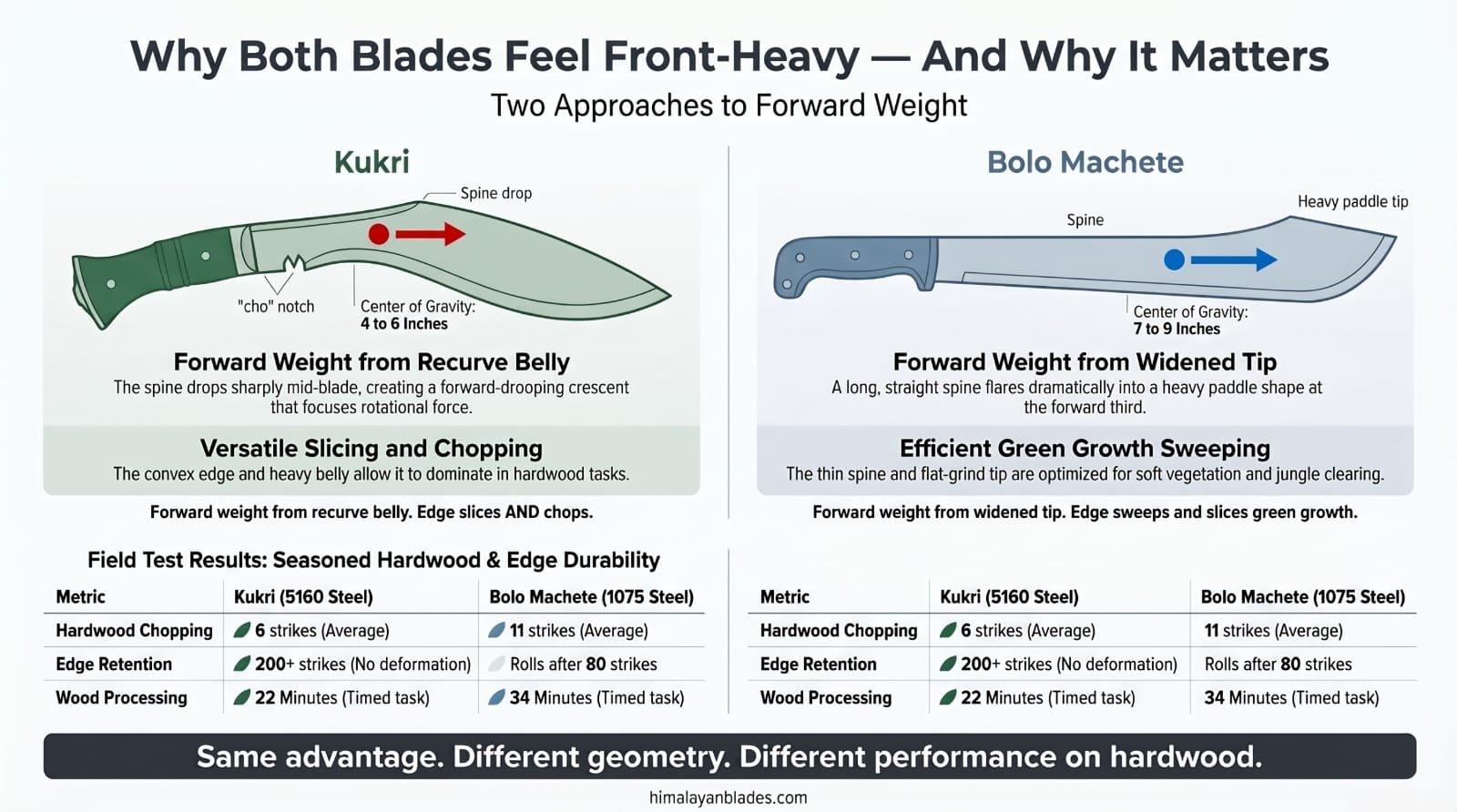
We performed a baton striking edge retention test and struck a hard, seasoned wood block 200 times per blade. After 200 strikes, the 5160 kukri was still able to cut paper easily like a razor, but it was not sharp enough to shave hair. The 1075 bolo machete showed edge rolling after 80 strikes on the same block.
Grinding geometry explains this. The convex edge of the kukri spreads impact across the edge better than the flat grind of the bolo machete. As a result, the flat grind concentrates stress and fails quickly.
Additionally, the 1075 steel runs a uniform hardness, and having a flat grind, creates a single point of failure after repeated impacts or chopping.
Battling the Elements: Base Camp Wood Processing Test Results
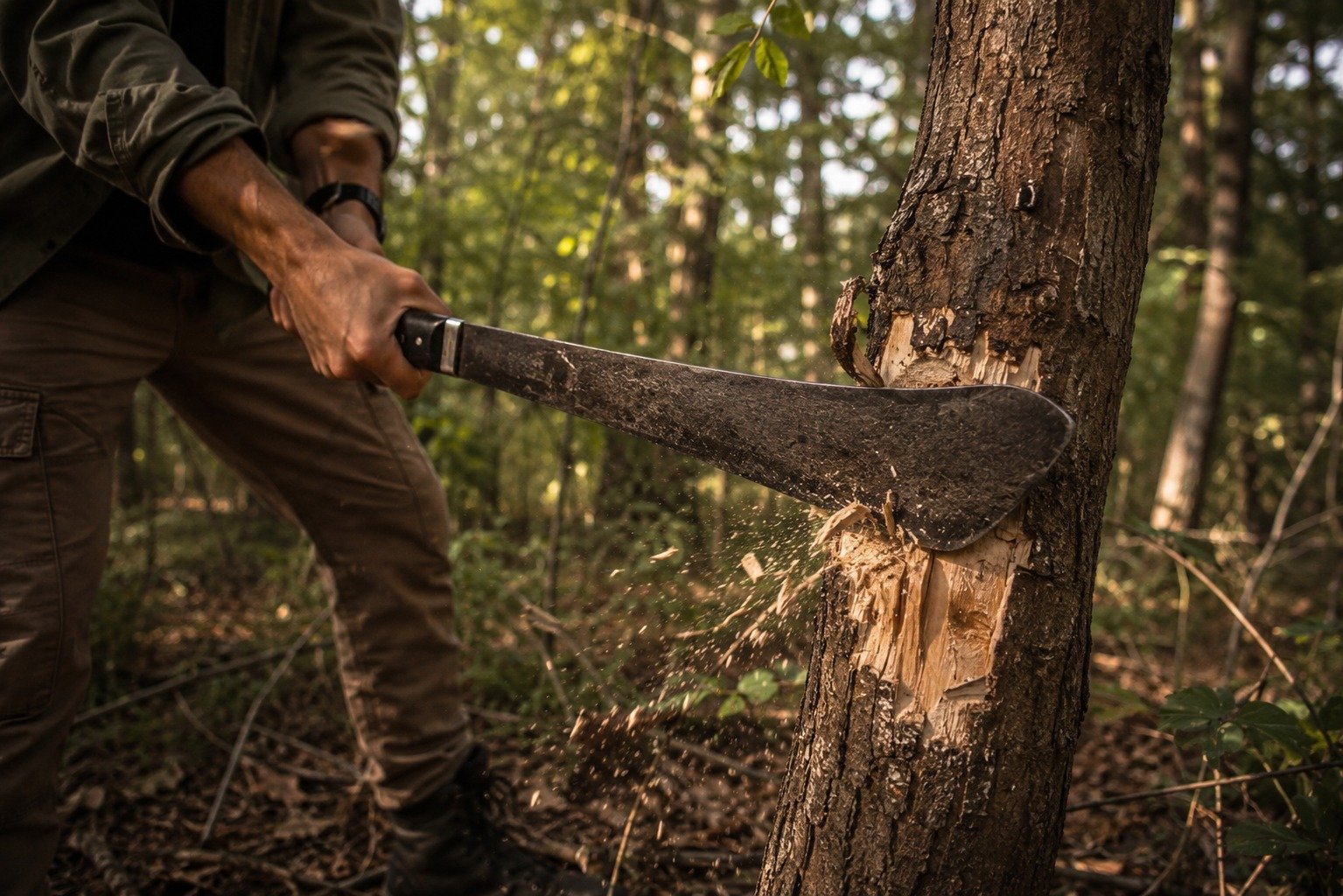
At base camp in Nepal, we set the same firewood processing task with a participant using each blade in a separate, timed session.
The task was to pack a standard bushcraft wooden box using raw branches from the surrounding field. The task took 22 minutes using the kukri, while it took 34 minutes with the bolo machete. When working on branches less than 1 inch in diameter, the bolo machete was about the same as the kukri in performance. However, on branches greater than 2 inches, the kukri’s convex edge and the blade’s forward belly delivered a lot more power per strike. Consequently, this reduced the total number of strikes per cut to a great extent. Since the kukri handles both chopping and fine splitting from one blade, it reduces tool transitions. The bolo machete required a switch to a different knife for smaller splitting tasks. This added time and effort for every branch over 2 inches in diameter.
Steel Comparison: 5160 Kukri vs Bolo Machete Steels
The table below shows how our tests and results are consistent with the metallurgical data. Steel and the processes used to control the microstructure of the steel after casting to determine edge life, not blade shape.
| Specification | Himalayan Blades Kukri (5160) | Quality Bolo Machete (1075) | Budget Bolo (1045) |
| Steel type | 5160 High Carbon Spring Steel | 1075 High Carbon | 1045 (budget) |
| Carbon content | 0.56 to 0.64% | 0.70 to 0.80% | 0.43 to 0.50% |
| Chromium | 0.7 to 0.9% | Negligible | Negligible |
| Edge hardness (HRC) | 52 to 56 (differential) | 52 to 58 (uniform) | 42 to 52 (uniform) |
| Spine hardness | 30 to 40 HRC (soft spine) | Same as edge | Same as edge |
| Heat treatment | Oil quench, double temper | Oil quench, single temper | Water quench or none |
| Edge grind | Convex (chip-resistant) | Flat (slicing) | Flat (thin) |
| Differential hard. | Yes | No | No |
Check out how a kukri and a machete performs against each other.
Kukri vs Bolo Machete: Field Use and Task Comparison
The bolo machete performs well in the wet jungle and on the green growth seen in agriculture. Its flat grind and wide tip facilitate cutting sugarcane and clearing thick stemmed plants and soft vegetation. The kukri, however, outperforms the bolo machete in 6 of 7 standard field tasks. These include: chopping hardwood, batoning, food prep, processing game, making a shelter, and defense.
The only task the bolo machete does a relatively good job at is clearing soft vegetation. A flat-ground thin edge sweeps green growth more efficiently than the kukri’s heavier convex bevel. The bolo machete is a good tool for people who work in the wet lowland jungle exclusively. In every other environment that contains hardwood, our test data shows the same outcome. The kukri handles more tasks per gram of blade weight.
To view performance tables and a full multi-blade comparison, visit our kukri vs machete guide on HimalayanBlades.com. It also includes the full Gurkha history.
Kukri vs Bolo Machete: FAQ
Which is better, a kukri or a bolo machete, for survival?
The kukri is better, especially in mixed terrain. Our test data shows the kukri outperformed the bolo in 6 of 7 standard field tasks. These include chopping hardwood, batoning, food prep, processing game, making a shelter, and defense.
The bolo excels at clearing sustained soft vegetation. For a single tool survival kit, the kukri is a better choice.
How is the bolo machete different from a regular machete?
The bolo has an increased tip width that moves the center of gravity toward the tip of the blade. This lets the bolo chop hardwood better than a standard machete. The bolo has a thin spine and a flat grind. As a result, it does not outperform the kukri on hardwood chopping or edge retention. The bolo is a great machete for chopping, but it will not substitute for a kukri.
What allows the kukri to outlast the bolo machete in edge retention?
There are two main aspects. First, the kukri has a convex bevel. This allows the chop’s impact to spread along the edge, preventing the apex from taking a concentrated hit. Second, the bolo has a flat grind. This means the edge takes a concentrated impact and runs at uniform hardness. As a result, the edge of the bola machete fails faster than the kukri.
Buy a Hand-Forged Kukri Direct from Nepal
The data from our edge retention, chopping tests, and wood processing show one consistent result. The hand-forged 5160 kukri outperforms the bolo machete on every cross-cutting task. Each kukri comes with steel specs, evidence of the heat treatment, and contact info for the maker after purchase.
Want to build a kukri and purchase direct from the manufacturer? Browse the full shop at Himalayanblades.com/shop, including the Military Series and the Villager Series. Alternatively, reach out to us for a custom kukri.
The price of a kukri knife incorporates only the cost of materials and craftsmanship – there is no markup for distribution costs. Gurkha kukris are hand-forged and designed to withstand more than a decade of field use; the price at Himalayan Blades reflects that.
Research Sources:
The steel data for 5160, 1075, and 1045 were referenced from the AISI reports and the Thomas Net technical library. The test data came from Himalayan Blades Nepal’s chopping and edge retention tests. Overall, we conducted these over three months, evaluating both seasoned and green wood.