
The kukri is one of the most adaptable knives in history, from outdoor use to everyday use; they have been around for many generations because of their ability to give you more value for your money. The traditional shaped blade from the curve creates a larger amount of cutting power with less effort than a straight knife would require. Therefore, by using less energy, it produces greater efficiency for you, whether taking a cut out of a tree or slicing an apple.
Not all kukris are created equal; select the right size and weight according to the activity you are doing, as this will help ensure that you remain safe and able to perform the task effectively. Therefore, follow the proper size guidelines to determine the appropriate size of your kukri.
What Is a Kukri Knife?
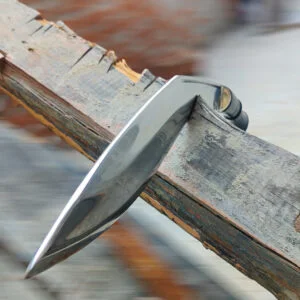
The kukri knife is a traditional curved-blade knife with a forward-weighted design, which makes it sharp and versatile for cutting, chopping, and doing defensive tasks.
The blade curves inwards and has a broadening out towards the tip; this forward weight gives the kukri the ability to create natural chopping power and to give a much smoother cut than with a straight knife.
The kukri has a long history as a traditional kukri knife originating from Nepal, where it was used as an everyday utility and used extensively by Gurkhas, who used it as their main weapon. It has now become extremely well-known and used throughout the world for outdoor, survival, and practical purposes.
Unlike most straight blade knives, which rely entirely on your arms, the kukri relies on the shape (geometry) of the blade to do more than you could do with just your arm strength!
Also Explore: The History and Significance of the Khukri
Why Should You Buy a Kukri Based on Your Purpose?
When selecting a kukri knife for your needs, the dimensions of the blade will have an influence on the form, control, effectiveness, and safety of the knife.
A heavy camping kukri may feel uncomfortable and awkward for cooking. An everyday carry kukri will probably not perform well when chopping wood. Each task requires different proportions of size and strength.
Whether you require an EDC kukri, one for camping, one for cooking, or a self-defense kukri, you will achieve better results and greater safety if you choose the right size and strength of blade for each purpose.
Those who are educated in the purchasing process select those kukris according to the purpose they will use them for.
How Does a Curved Blade Knife Work Better Than Straight Knives?
The forward curve of a curved blade, together with the way it naturally chops, provides more cutting force for less work than a straight blade will give you.
Thus, the advantages of using a curved blade are
- Increased leverage at the tip
- Greater impact force when chopping
- A more natural slicing motion when cutting
- A greater degree of control while doing repetitive cutting tasks.
While straight-blade knives make linear cuts, curved-blade knives chop and slice at the same time, which allows for greater efficiency, reduced fatigue, and increased accuracy.
Purpose-Based Kukri Selection
1. Which Kukri Knife Is Best for Self-Defence?
A compact, balanced kukri with a medium-length blade is the best option when considering a self-defence knife.
Main factors to consider:
- The medium-length blade for control and quick handling
- The grip should be solidly held onto the knife for non-slip control.
- The weight should be evenly distributed along the body of the knife.
- The knife should be comfortable to carry/use.
Smaller kukris with controlled curves will have better manoeuvrability than larger curved knives. Safety, legality, and training should always be considered first and foremost.
2. What Type of Kukri Is Best for Camping and Outdoor Use?
A heavy-duty kukri knife with thick, curved knife blades is best for camping tasks like chopping wood and clearing brush.
- Thick spine for strength
- Full tang construction
- Slightly heavier weight
- Durable steel
With its forward curve, a kukri will greatly improve your ability to chop without having to take huge swings. This is very helpful during long periods of time outdoors because you will conserve some energy by using a kukri for camping.
3. Is a Kukri Knife Good for EDC (Everyday Carry)?
A small or mini kukri (an EDC (everyday carry) option) will be fine as long as it meets these requirements:
- Compact Size.
- Lightweight.
- Legal Length (Blade length must not exceed applicable laws).
- Easy to carry in a sheath.
Your everyday carry (EDC) kukri knife should feel comfortable carrying with you at all times, and you should be able to perform small cutting tasks with it without feeling burdened by excess weight.
4. Can You Use a Kukri Knife for Cooking?
A kukri knife can be effectively used as a food preparation tool as long as it is light with a thin, curved blade.
Curved blades can be used for:
- Chopping vegetables evenly
- Cutting meat easily
- Using a rocking motion to create clean cuts
Kukri knives used in cooking have similar functionality to chef knives (in that they provide efficient cutting with a good level of control). Make sure you are using stainless or food-safe knives and maintain good hygiene habits while preparing food.
Comparison & Decision Support
Kukri Knife Size Guide Based on Use
- A small kukri is best for EDC, cooking, light tasks
- A medium kukri is best use for self-defence and general utility
- Large kukri suitable for camping, survival, heavy chopping
Choosing size based on use prevents fatigue and improves safety
What Blade Material Is Best When Buying a Kukri?
Stainless steels are easier to maintain than high-carbon steels; they do not corrode easily when properly cared for, regardless of their application.
High-carbon steels provide a longer-lasting edge than other types of cutting tool materials, as well as providing better results when doing hard work. They require proper care before they will corrode, which means that users should apply appropriate rust/anti-corrosion products to their high-carbon steel tools.
Handle Types and Grip Safety in Curved Knives
The type of handle on a curved blade knife can make a big difference in the level of control and safety the users have when cutting with them.
Here are some important characteristics to look for:
- Textured grip
- Comfortable shape
- Secure finger placement
- Moisture resistant
A comfortable grip will lead to increased control and a reduced likelihood of accidental injury when using curved blade knives.
Things to Check Before You Buy a Kukri Knife
When purchasing a kukri knife, please consider the following:
- Your intended use (camping, EDC, culinary, self-defense)
- Length of blade
- Weight versus balance
- Design of the blade (curved)
- Support for the user’s grip (ergonomics)
- Quality of the steel
- Legal requirements
When selecting a kukri, remember that your primary reason for making a purchase should be your intended use, rather than simply how it looks.
Common Mistakes People Make When Buying Curved Knives
Many people purchase kukri knives without taking into consideration the size and weight of the knife, along with its intended use.
Following are the common problems that arise as a result of this:
- Buying a blade that is too heavy
- Lack of comfort on the grip
- Buying a knife that is decorative instead of functional.
- Non-legal knives.
Matching your tool for the job will prevent these things from happening.
FAQs
Can I carry a kukri legally?
Laws governing kukris differ according to where you live; however, most areas allow ownership, but there may be limitations when carrying one in public. Always check your state/local law.
Does a curved blade cut better than a straight blade?
Curved blades usually have more chopping power and cutting efficiency than straight blades, but straight blades work better for precision slicing. It mostly depends on the type of work being done.
Is a kukri suitable for beginner users?
Yes, a smaller and lighter kukri is easier for beginners to gain experience and learn proper use.
How sharp should a kukri be?
A kukri must be sharp enough to easily and cleanly do its intended purpose, without having to exert excessive force. Having a properly developed edge improves the user’s safety and their performance.
What makes curved knife blades powerful?
Their forward curve concentrates weight at the tip, increasing leverage and cutting force with less effort.
Conclusion
Making a smart, mindful decision when selecting a kukri involves much more than simply choosing the largest and heaviest blade.
When you buy a kukri based on purpose, you get better control, improved safety, and higher performance. Whether you need a kukri for camping, a kukri for self-defence, an EDC kukri knife, or a kukri knife for cooking, selecting the correct size and design makes all the difference.
Be intelligent, make smart choices, and you will find the kukri you select will serve you very well for a very long time.