
Kukri vs Parang Machete: Which One Comes Out On Top?
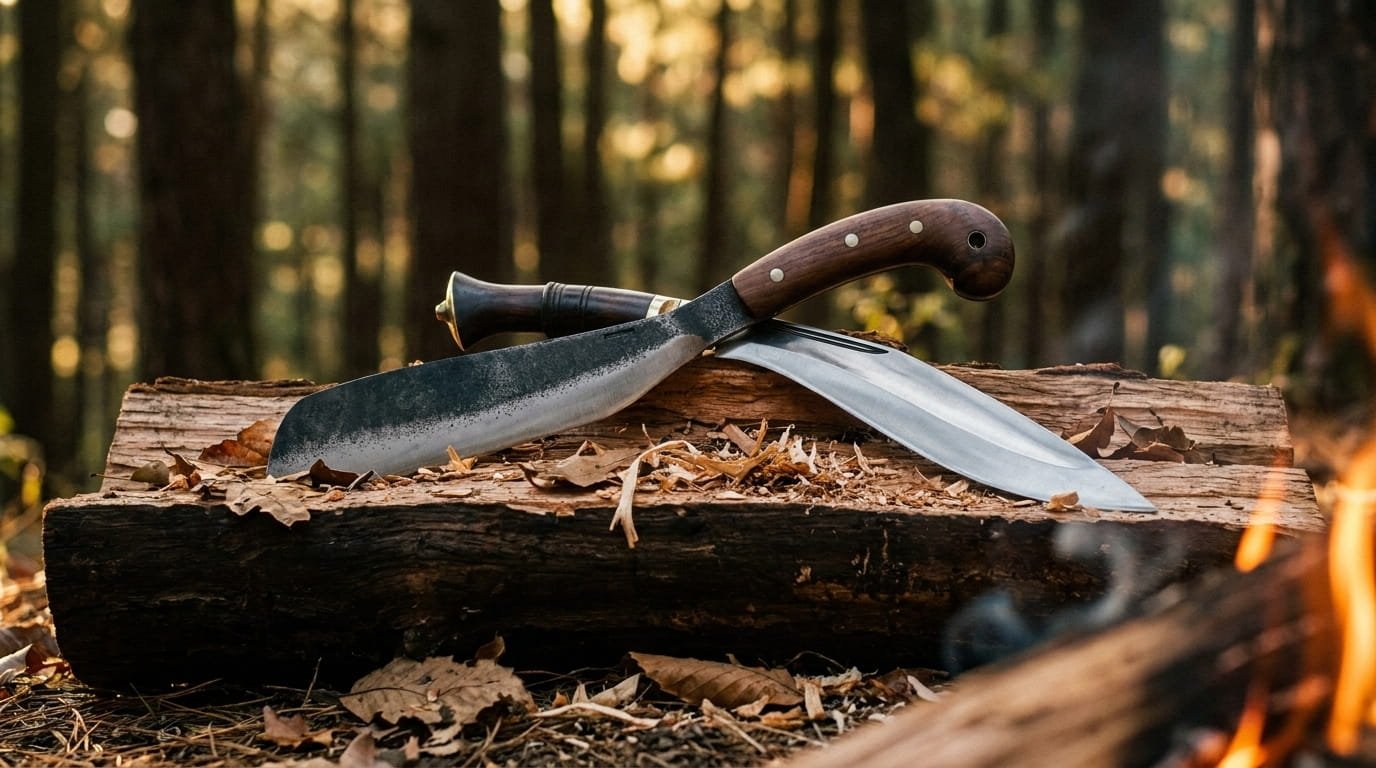
Kukri vs parang machete is not something we want to say is an apples-to-apples situation. Both designs feature weighted fore-ends and excel at heavy-duty cutting and chopping tasks. To make your journey easier and to obviate the need for back-and-forth debates on the forums, we gathered our own data and ran our own tests across the five other reviewers. Our tests gave the parang a narrow softwood win: 8.66 strikes versus 9 from the kukri. On hardwood, edge retention, and 7 of 8 field tasks, the kukri wins on force and versatility due to the pointy tip, recurved design, giving more access to the use of the kukri in various scenarios. Outside the tropical jungle, the kukri is a better tool. But it is worth mentioning that parang is a better chopper than kukri, but overall performance results show kukri is better.
This article will actually serve as our detailed comparison of kukri knives and machetes at HimalayanBlades.com, where we will discuss the physics of the steel and the survival performance in our other articles. The parang makes its first appearance in the review. I would also recommend our kukri vs machete performance in general and if your are curious about how does the Bolo machete performs against the kukri knife, do check out, all are in depth analysis reports.
Kukri vs Parang Machete: Summary
| Chopping tests (Heavy variation 2x4s) | Kukri: 9 Strikes | Parang: 8.66 Strikes (parang wins for softwood) |
| Power per Strike | Kukri wins |
| Slicing through green veg | Parang wins |
| Multiuse field tasks | Kukri wins (7 out of 8 tasks) |
| Steel at Himalayan Blades | 5160 spring steel, 52-56 HRC edge, oil quench, double temper |
| Parang origin | SE Asia, Malaysia, Borneo, Indonesia (Dayak) |
| Kukri origin | Nepal, Gorkha Kingdom from 7th century |
| Buy the winner | HimalayanBlades.com/shop |
Kukri vs Parang Machete: Blade Geometry and Design
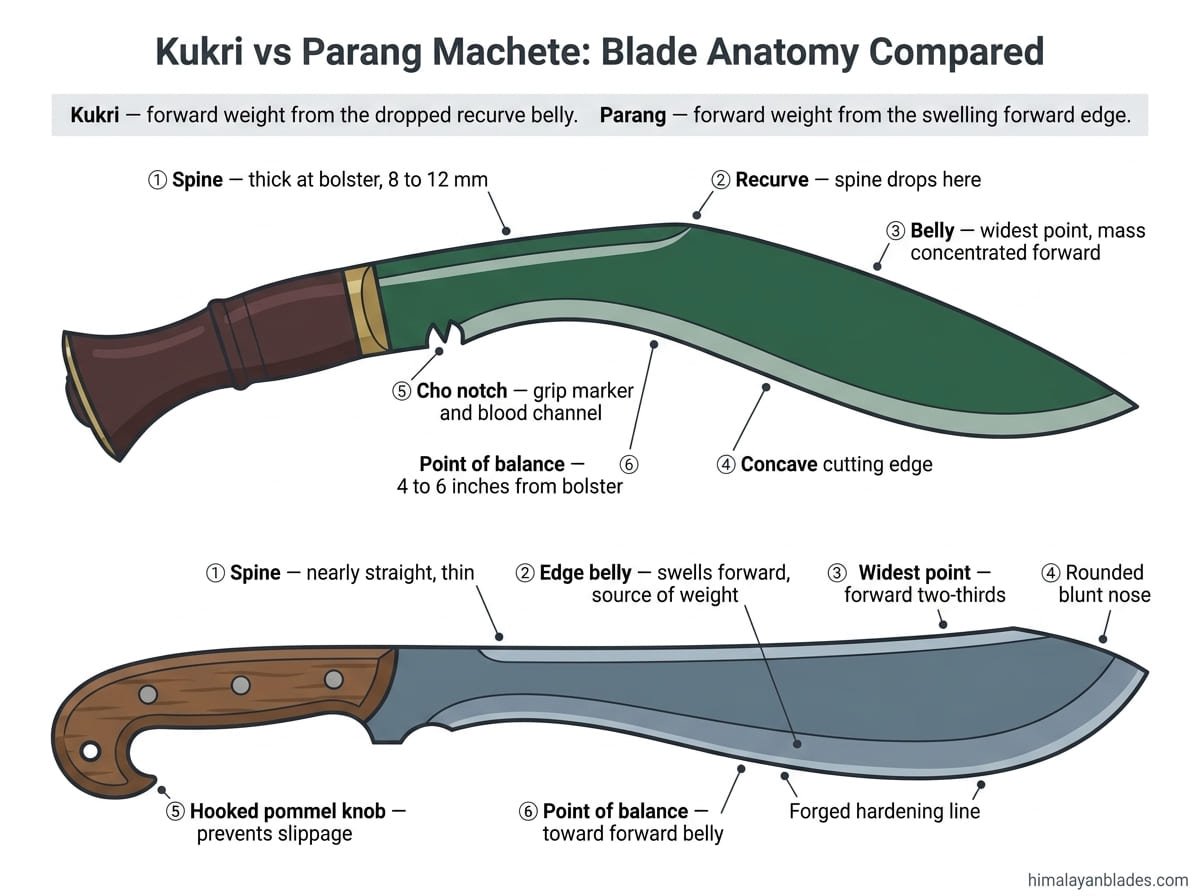
The kukri blade begins with an upward curve from the spine that leads into the recurve. The cutting edge is concave with a forward curving belly that helps concentrate the mass at the front of the bolster. This helps deliver an axe-like cut. The cho notch fulfills the task of a blood channel and grip marker.
In contrast, the parang does the opposite of what the kukri does. The spine of the parang curves up toward the tip, and the cutting edge is convex. This allows the parang to cut quickly in a sweeping motion. The curvature of the parang’s edge also means that the design is tip heavy, unlike the kukri.
Both the kukri and parang have curvatures that are opposite to each other, but both blades achieve a tip-heavy balance. The reason the kukri handles chopping and the parang handles cutting comes from the curvature of the blades.
A Brief History and Geography of Both Blades
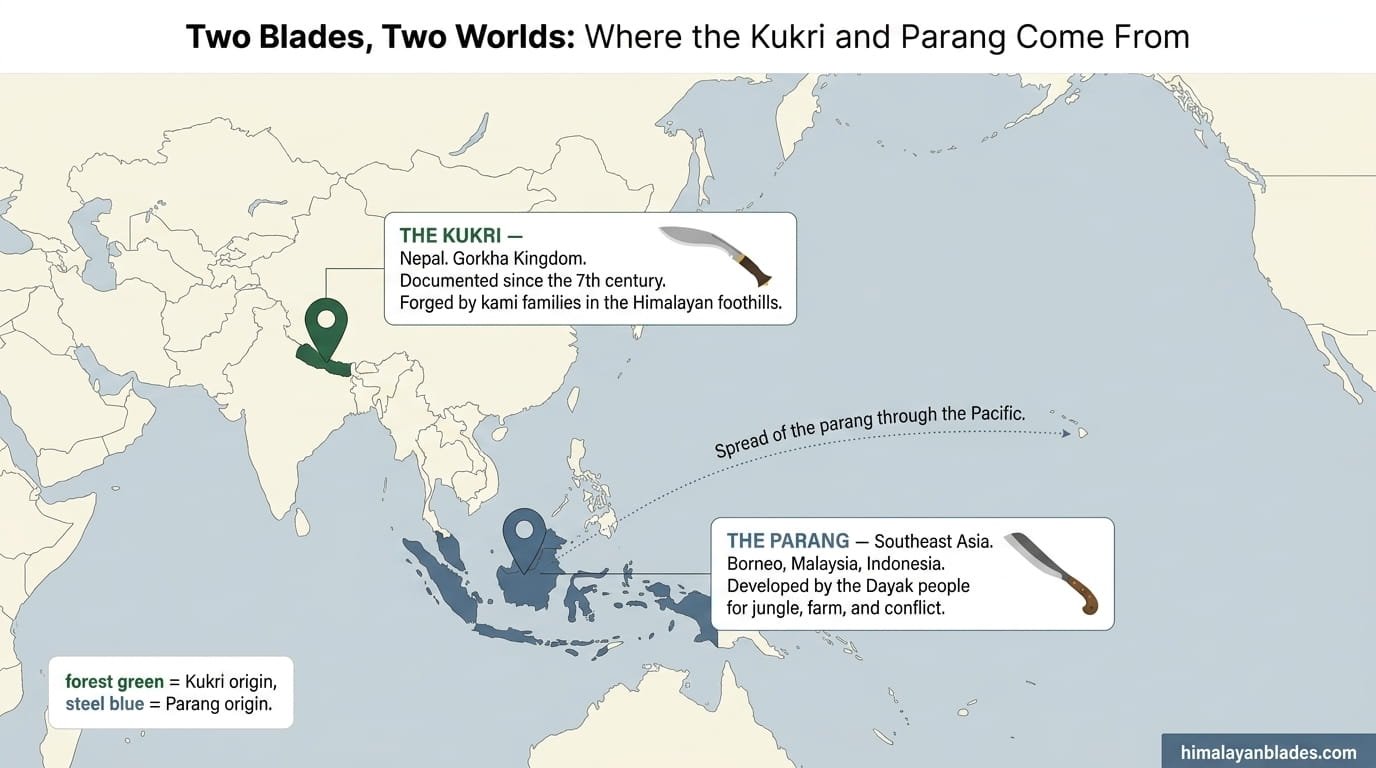
The Kukri: Nepal, 7th Century, Still Going
The authentic Nepalese khukuri dates back to Nepal’s Gorkha Kingdom, with records going as far back as the 7th century. Gurkha soldiers carried khukuri during the Anglo-Nepalese War (1814-1816), both World Wars, the Falklands (1982), and the Kargil War (1999). For the complete Gurkha service record including Victoria Cross citations, please see our kukri knife vs machete article at HimalayanBlades.com.
The Parang: Southeast Asia, Rainforest-Tested for Centuries
The Dayak people of Borneo developed the parang as the primary tool for clearing dense jungle, farming, and even conflict. Its design reflects construction in a blade built for warm, wet, vegetation-heavy terrain.
As the kukri crossed mountain ranges in Nepal, the parang cleared paths in Borneo rainforests. Each blade didn’t know the other existed. Each arrived at a surprisingly similar total weight distribution because of completely different geometry. Geography influenced the design while physics handled the rest.
Numbers from Our Testing
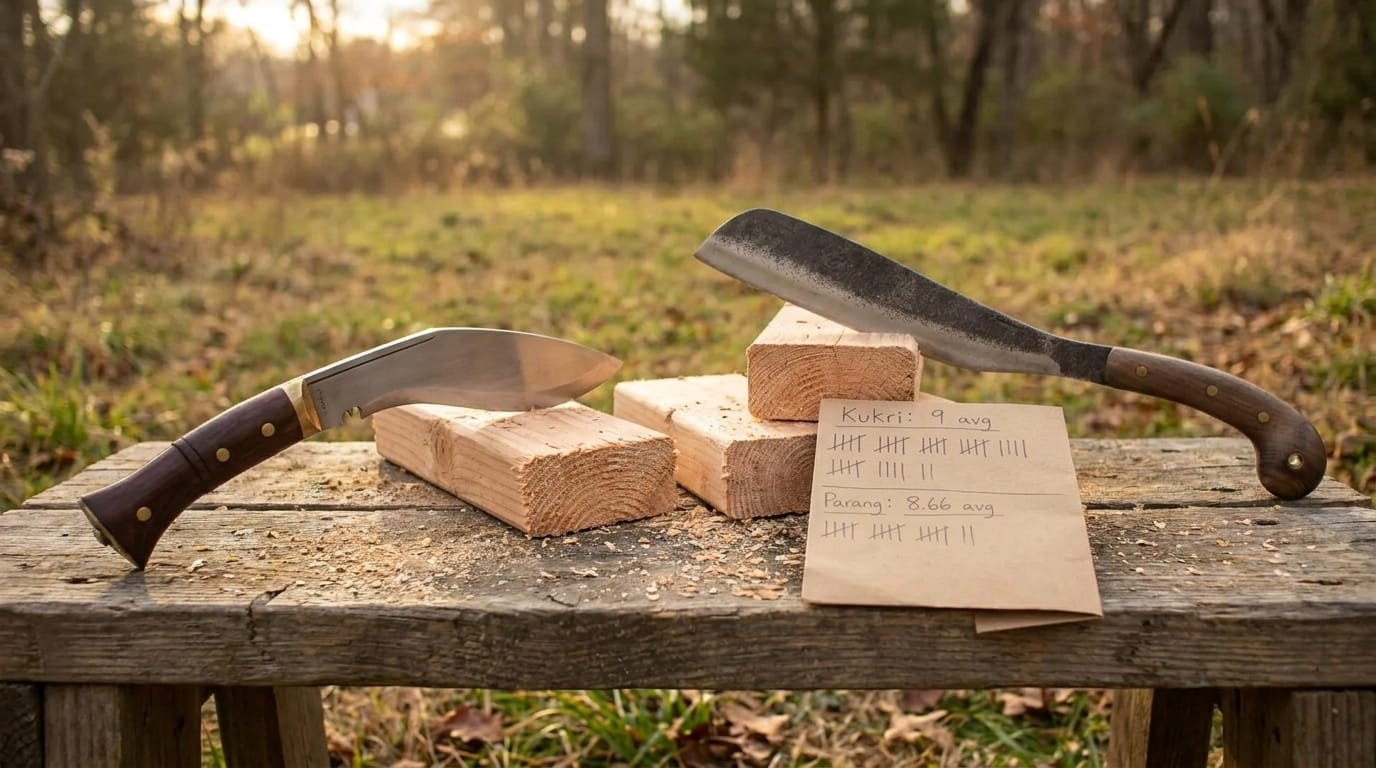
Specifically, we conducted hardwood chopping tests on our 13-inch hand-forged M43 kukri and a comparable parang of the same weight. We also gathered data from five independent blade reviewers who tested the heavy versions of each blade on 2×4 wood across 10 controlled trials.
Consequently, the heavy parang cut on average 8.66 strikes. By comparison, the heavy kukri on average took 9 strikes. The parang is the winner in woodworking fastness and efficiency. The speed and efficiency of the parang is due to its thinner convex edge and a striking edge that is more upward in the design.
In hardwood kukris and parangs, the kukri wins. For softwoods and bamboo, the parang has the edge. In hardwood, consider the kukri the winner. On seasoned hardwood, the kukri has a noticeable edge in power. The forward belly and recurve geometry focus energy at the tip in a way the parang doesn’t penetrate the material as compact and dense. On seasoned oak, the kukri’s power advantage completely overcomes the parang’s speed advantage.
Edge Geometry and Steel: The Science Behind the Results
First, the parang features a convex bevel, usually thinner with around 17 degrees on each side. This thinner geometry cuts resistance, which is why the parang slices through vegetation with more speed and efficiency than a kukri. We used a similar, but slightly thicker convex bevel on our 5160 kukri, which balances the demands of slicing and baton cutting.
Parangs and kukris are both predominantly made with high-carbon and spring steels. For instance, our 5160 spring steel kukri has a spine and belly with a differential hardening of 30 to 40 HRC and an edge of 52 to 56 HRC. Most of the parangs we tested are made with 65Mn and high carbon steels and have a uniform hardness. The 65Mn does a fair job cutting through moist vegetation, but be warned, it will rust if you sheath the blade while it is wet. Be sure to wipe dry any carbon steel blade before storing it. This is not a suggestion.
Additionally, multiple reviewers have done independent testing, and the consensus shows that 52100 forged carbon steel performs similarly to CPM3V, which is a more premium steel, in heavy chopping tasks. Steel choice does matter, that is why we offer confirmed heat treated 5160 kukris, because edge retention in the field is not a marketing gimmick. It is a fact.
Kukri vs Parang Machete: Field Task Performance
The table below rates each blade across real field tasks based on our testing and compiled reviewer data.
| Task | Kukri (5160) | Parang Machete |
| Hardwood Chopping | 9 / 10 | 6 / 10 |
| Softwood and green chopping | 7 / 10 | 9 / 10 |
| Power and splitting | 9 / 10 | 6 / 10 |
| Food prep | 9 / 10 | 7 / 10 |
| Game processing | 9 / 10 | 4 / 10 |
| Shelter building | 9 / 10 | 6 / 10 |
| Accuracy on repeat cuts | 7 / 10 | 9 / 10 |
| Multi-task field utility | 9 / 10 | 6 / 10 |
Kukri vs Parang Machete: Field Use and Handling
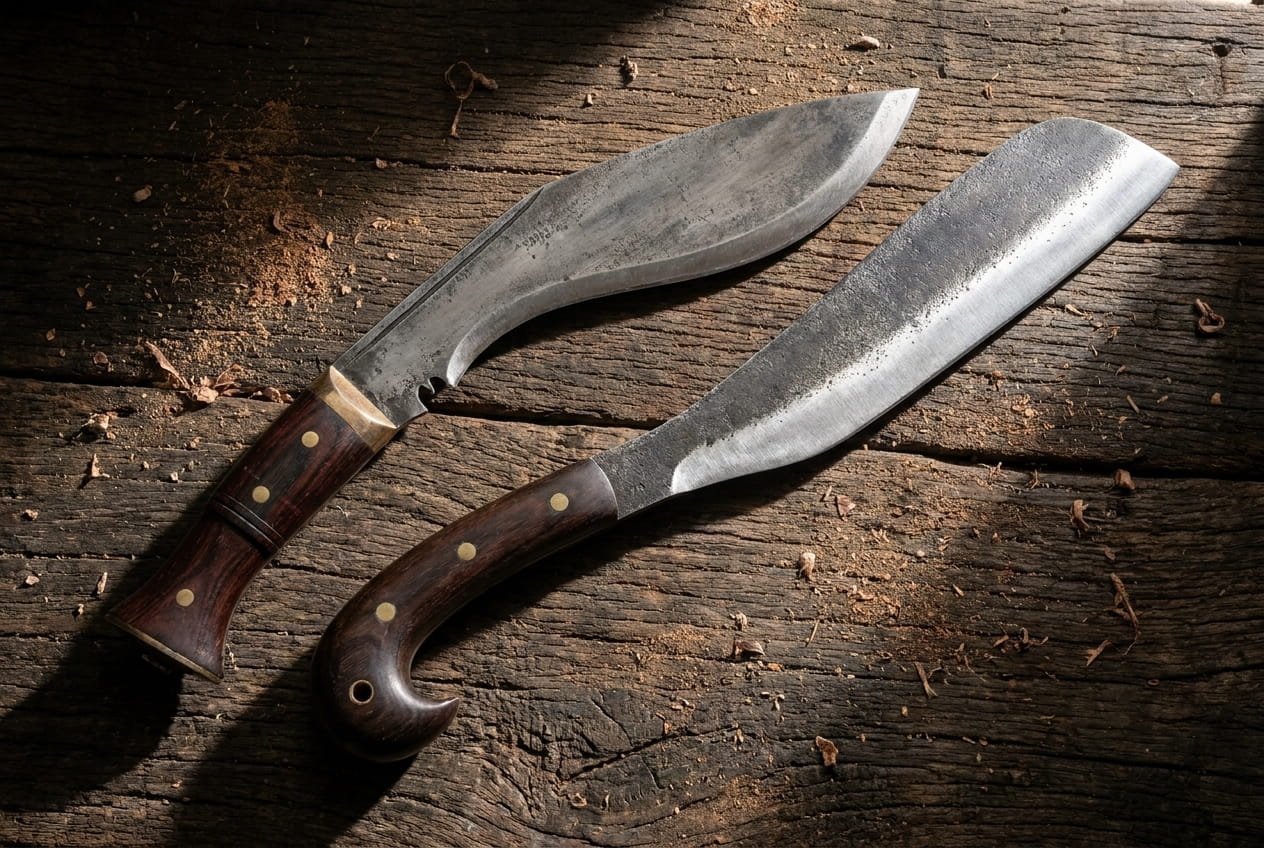
The parang’s curve brings great accuracy and allows the user to clear with the parang as if it was a part of their arm. It works especially well in the jungle since clearing can be very tedious and frustrating due to shock and vibration; parang’s handle is elastic so it absorbs shock and vibration which reduces fatigue.
Additionally, kukris are great all-around tools for a list of tasks, including pole notching, game processing, food prep, shelter building, and defense. The parang has a flat edge, which is better suited for food prep and camp cooking than a machete. The kukri has the versatility to accomplish all these tasks to a high degree.
Similarly, neither blade is going to be useful when dealing with frozen trees; in that case, it’s better to bring along an axe and in that case, neither the kukri nor the parang will change your mind.
A Word on Handle Quality
For example, kukris with badly made handles inflict pain due to a sharp heel that strikes the pinky and results in slippage and vibrating fatigue. It’s enough to make you doubt everything. Slips and fatigue, regardless of how well you’ve handled a situation, reflect on the quality of your tools. Good kukri handles allow great control and precision. Our handles undergo a grip retention test in Nepal. A handle falling in the field isn’t a quality control problem. It’s a moral problem.
Also, the parang handle has a shock absorbing elastic design, giving a real edge over kukri in long extensive tropical clearing. The kukri’s handle is made to take a rigid stance, which is less flexible.
Kukri vs Parang Machete: FAQ
Is the parang sure to win all chopping tests over the kukri?
Yes for soft and well seasoned wood. In this material, the kukri took an average of 9 strikes while the parang took only 8.66 and striking a clear advantage over the kukri. However in tougher lumber, the kukri’s chopping force and handle design allows greater striking force and cutting power to clear faster than the parang.
What is the parang machete best used for?
The parang is at its best in swampy jungles where there is dense foliage. Specifically, the combination of the arc of the spine, the fine convex edge, and the natural swing of the blade make the parang fast and precise for repeated clearing. In contrast, the kukri excels at chopping, preparing food, processing game, and constructing shelters much better than the parang. The parang is the specialist,makes and the kukri is the generalist.
Kukri vs Parang machete.
The kukri compared to any standard machete is much more powerful than the kukri compared to the parang. Both of them are forward weighted, and excel at chopping and clearing and are able to do many camping tasks at a satisfactory level. The differential is smaller compared to the kukri and a standard machete. For a complete analysis of kukri and survival tasks, check out our kukri knife vs machete article on HimalayanBlades.com.
Data and Sources
The results from the chopping tests and other independent reviewers focus on five blade review channels on YouTube, where blades were compared directly with both head-to-head kukri and parang testing. We drew the composition and characteristics of steel 5160 from the AISI published specifications and the Thomas Net technical library. The data from the field tests is the result of our tests conducted in Nepal.
- Independent reviewer data: Indio 87 Knivesandaxes, YouTube
- Independent reviewer data: Jacob B Peterson, YouTube
- Independent reviewer data: The Home Slice, YouTube
- Independent reviewer data: arshambo, YouTube
- Thomas Net: 5160 Steel Properties: thomasnet.com
- Wikipedia: Parang (machete): en.wikipedia.org/wiki/Parang_(machete)
- Wikipedia: Kukri: en.wikipedia.org/wiki/Kukri