
Kukri vs Hatchet Axe: Which One Should You Take?
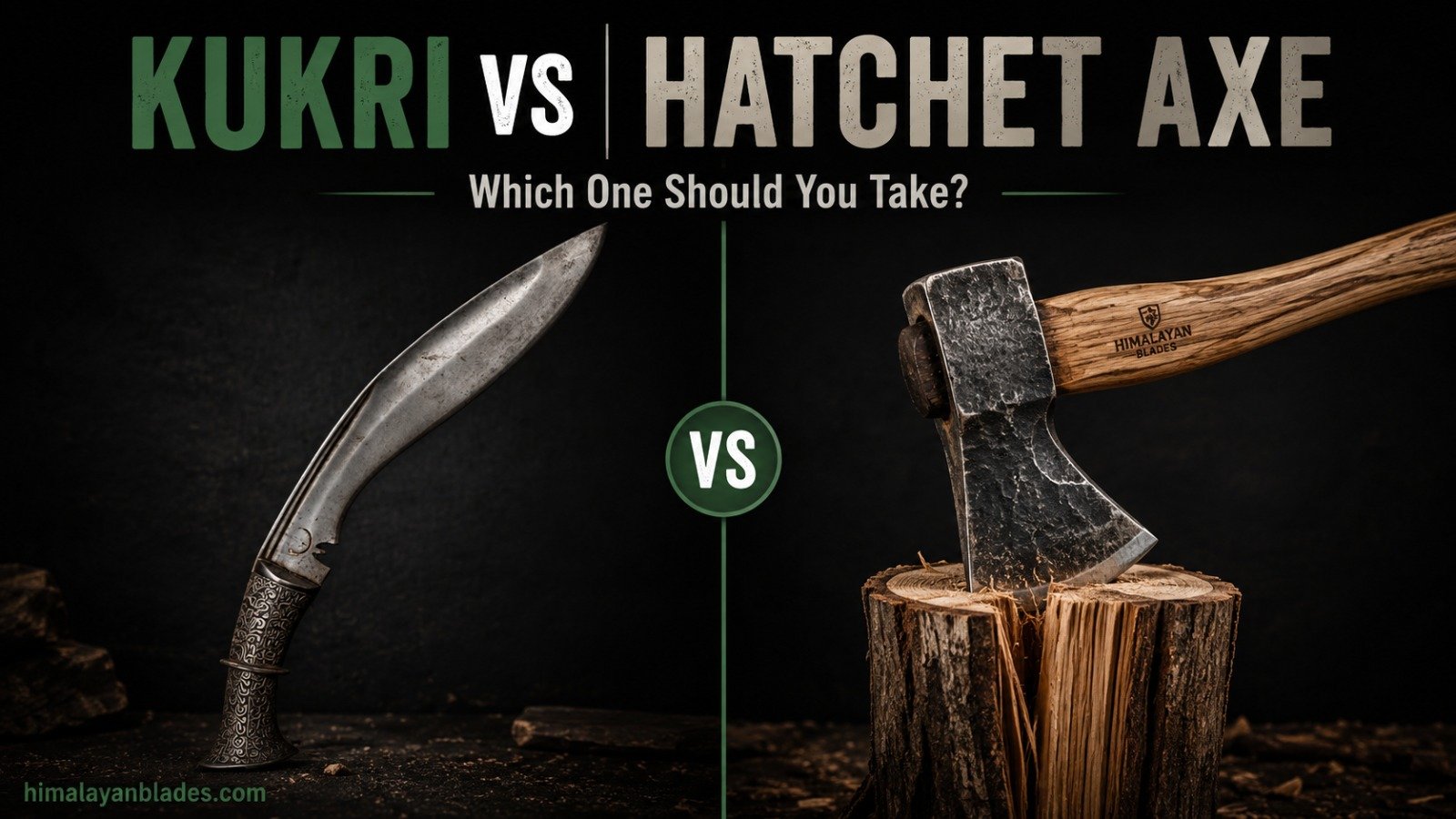
The kukri vs hatchet axe debate is one of the classic campfire disputes. One camp is all about the wedge. The other is all about the curve.
Given that we make kukris in Nepal, you can probably guess where our bias lies. That said, we put our kukris through the same tests we put axes through. For a more comprehensive kukri vs axe analysis, check out our kukri vs axe guide on the website at HimalayanBlades.com, and now let’s jump right into the more narrow and focused opponent.
Kukri vs Hatchet Axe: Overview
| Splitting wood | Hatchet wins due to wedge head. |
| Chopping and slicing | Kukri wins due to long edge. |
| Carving | Kukri can achieve 80 to 85% of performance of dedicated carving knife. |
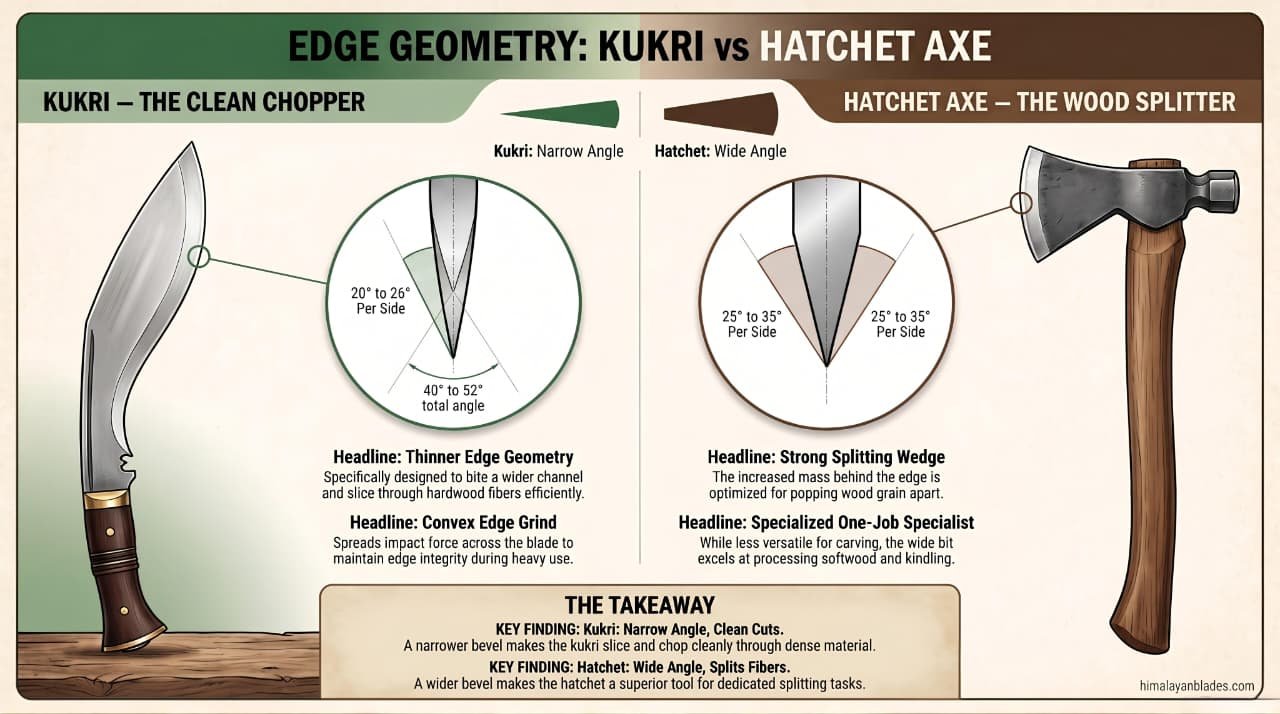
| Edge Bevel | Kukri (20 to 26 degrees; 40 to 52 total) vs Hatchet (25 to 35 degrees) |
| Weight | Kukri (450 to 650 grams) vs knife + hatchet combo (30 to 42 oz) |
| Calorie burn | Hatchet (due to mass being loaded at the head) |
| Shock absorption | Hatchet wins (kukri transfers shock) |
| Best one tool option | Kukri (85 to 90% functionality at 60% weight) |
| Internal Comparison | kukri vs axe guide (himalayan blades) |
Kukri vs Hatchet Axe: Origin and Geography
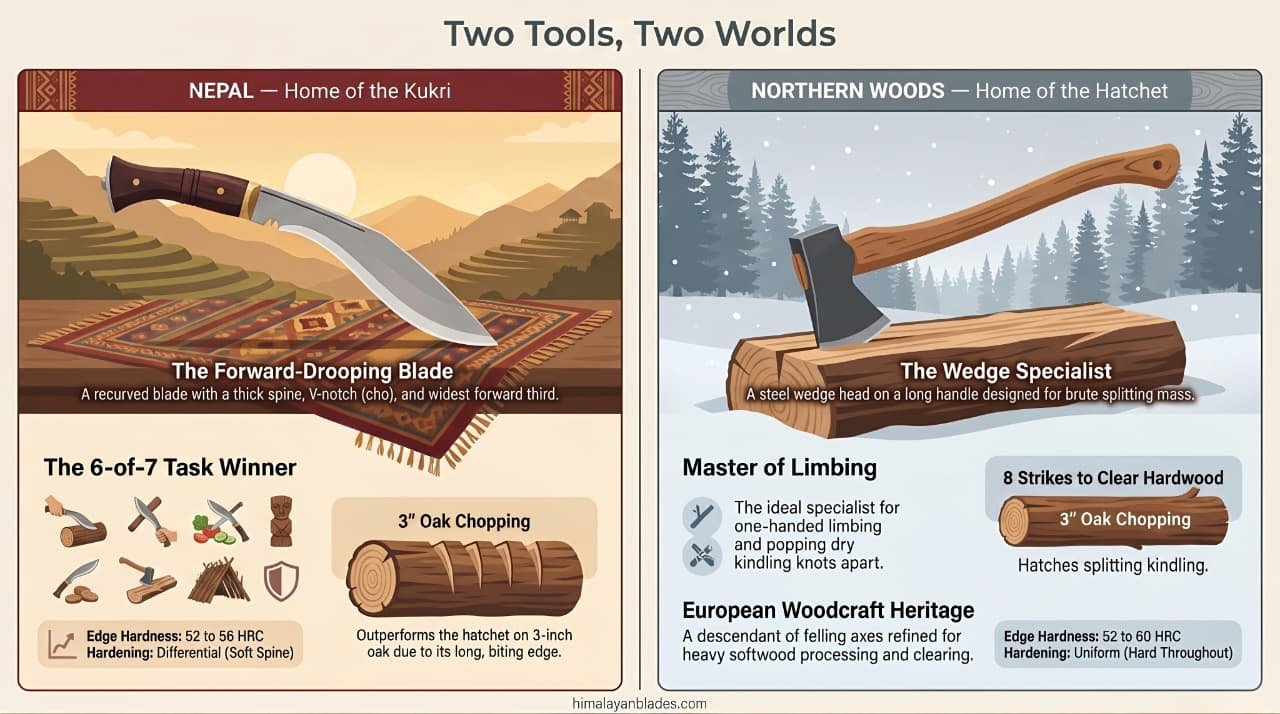
Kukri originates from Nepal. Hill communities have used it in Nepal for centuries as a farming tool, a kitchen knife, and a combat blade. Today, it serves the Gurkhas and is a national symbol of Nepal.
Compared to the hatchet, Kukri stems from the axe in Europe and North America. Woodsmen shrank the full axe to a one-hand tool used for splitting kindling and shaping timber. Also, a cold climate forest made the hatchet wedged head heavy as it would need to do a lot of splitting.
Nepal’s hardwood hills made the Kukri long slicing edge a slicing tool, while the hatchet’s splitting tool was made for the northern woods.
Kukri vs. Hatchet Axe: Blade Design and Physics
Hatchets and Kukris work differently. A hatchet’s center of mass at the head means every downward swing builds good momentum and transfers significant force without much effort from the arm. The hatchet’s flat hammer poll also makes it a mallet.
The Kukri reaches forward. This means its downward curve concentrates its force at the point of impact, and also aligns the edge to the cutting angle without requiring a correction of the wrist. Kukris are also structurally strong with a thick spine.
The Kukri also functions as a 3-in-1 tool. Precision, piercing, and carving work all happen at the tip. The center is for slicing and food prep, while the thick base does all the heavy chopping.
Our Chopping Tests: Kukri vs. Hatchet Axe
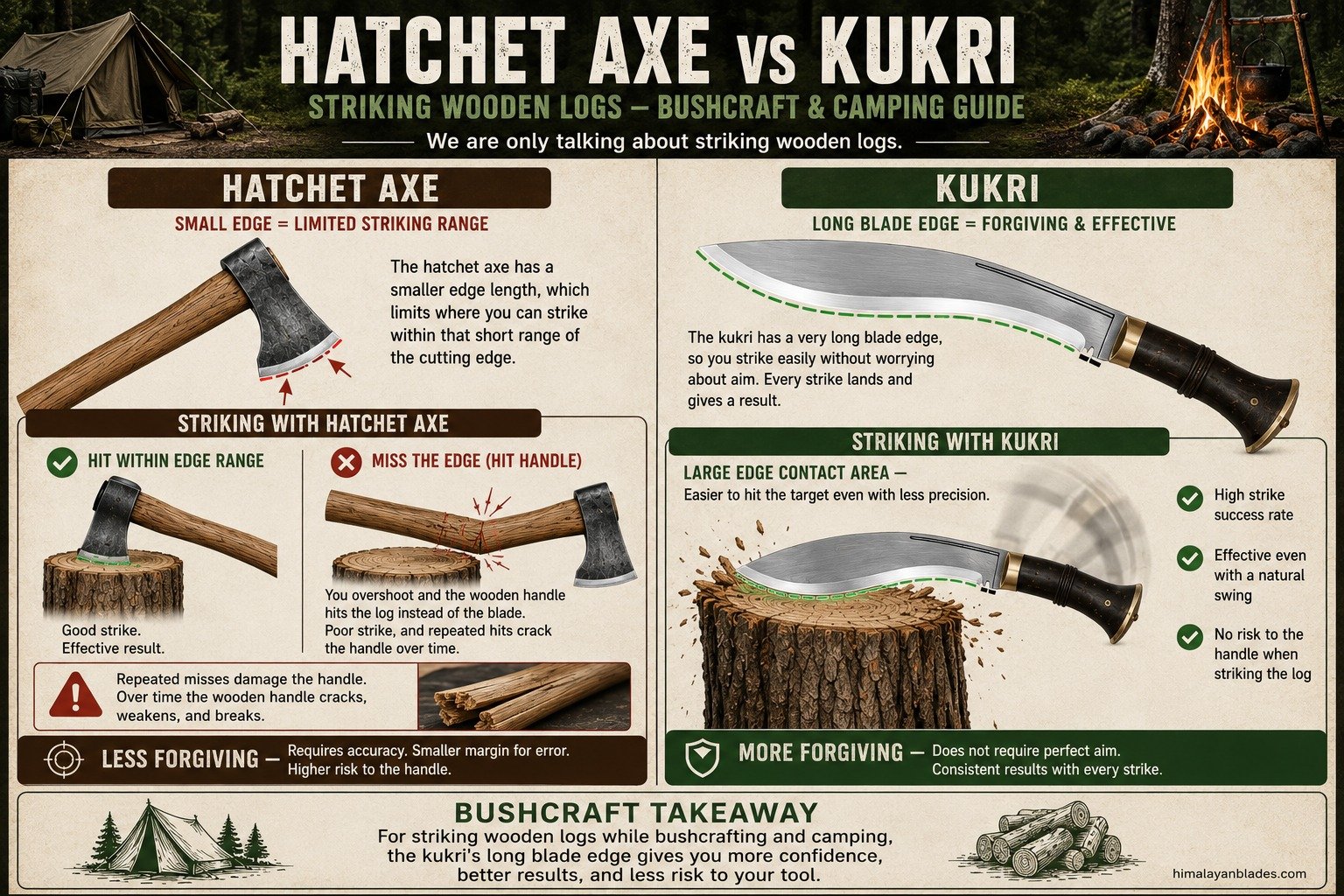
Chopping hardwood with a 13-inch hand-forged Kukri showed the forward-weighted blade beating a standard machete on seasoned wood. The hatchet axe was a real contender and proved to be quite the opposition for a reason.
Edge length is an advantage of the Kukri. Hatchets have the disadvantage of a short cutting edge, meaning every swing has to be dead on. Otherwise, the handle takes the blow, and eventually the wooden handle splinters.
The kukri has an advantage in that it has a long cutting edge. Because of this, you can be confident that you can strike and land a forceful cut on the target with every swing.
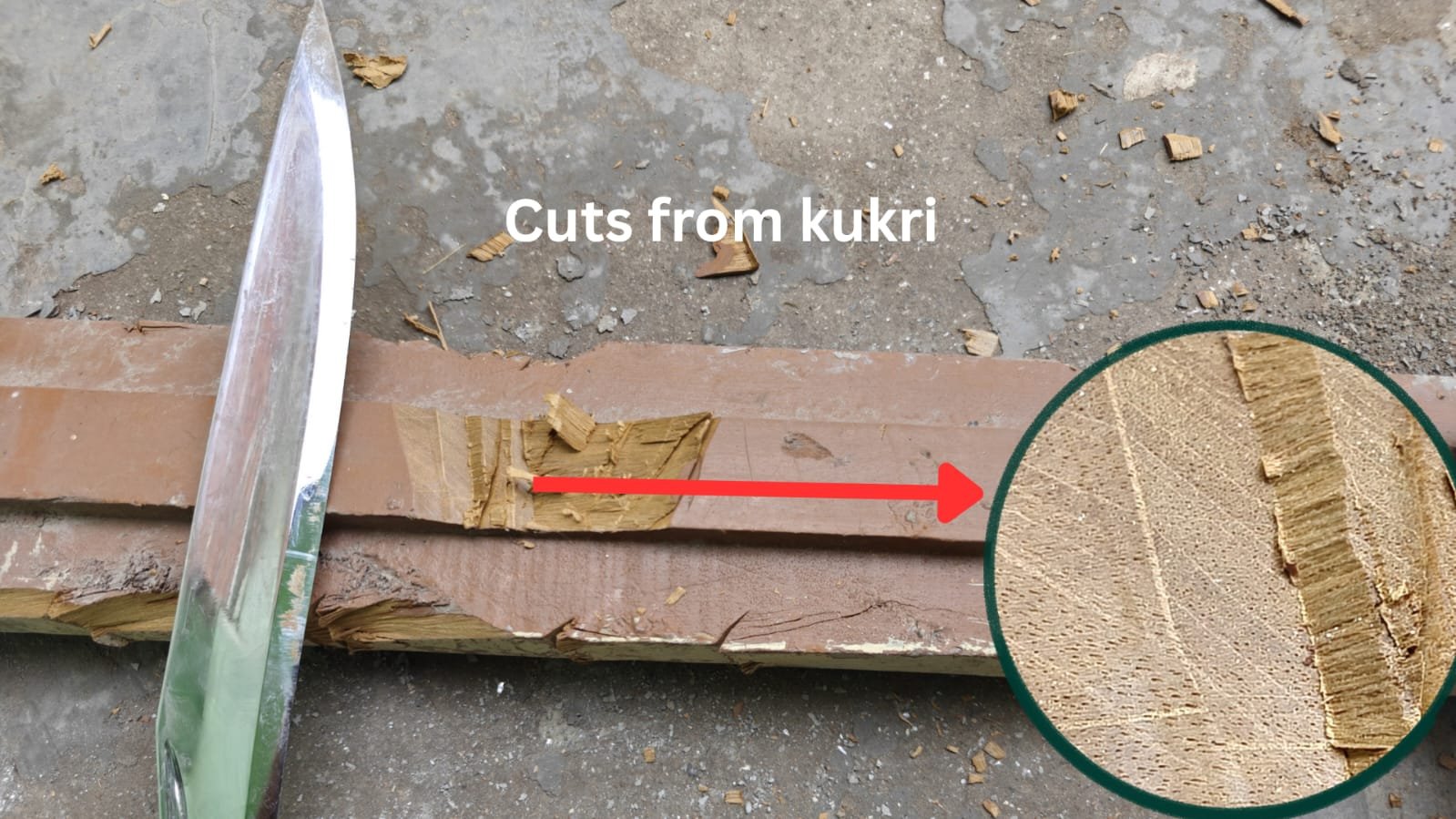
The second factor is bevel geometry. Our kukri edges are ground to between 20 and 26 degrees on each side, 40 to 52 degrees total, while a hatchet has an edge of 25 to 35 degrees on each side. This is the reason a hatchet can split, while a kukri can make clean and versatile cuts. You can explore our kukri here.
Kukri vs Hatchet Axe: Chopping Technique
Where only chopping is involved, the situation can be a bit more complicated. A hatchet has a longer handle, meaning it will chop more efficiently when working on thick, stationary logs. The kukri, on the other hand, can easily chop through flexible, moving targets, such as brush, saplings, and vines, that a hatchet will hit and fail to chop.
The technique also separates the two. A hatchet requires a point and swing, while a kukri is a bit more rewarding for a slight adjustment in technique. When striking wood with a kukri at an angle, the blade will skip, just like a flat stone skips across a pond, but this is a razor-sharp stone, and you can be sure it is headed for your shin.
Kukri vs Hatchet Axe: Splitting wood
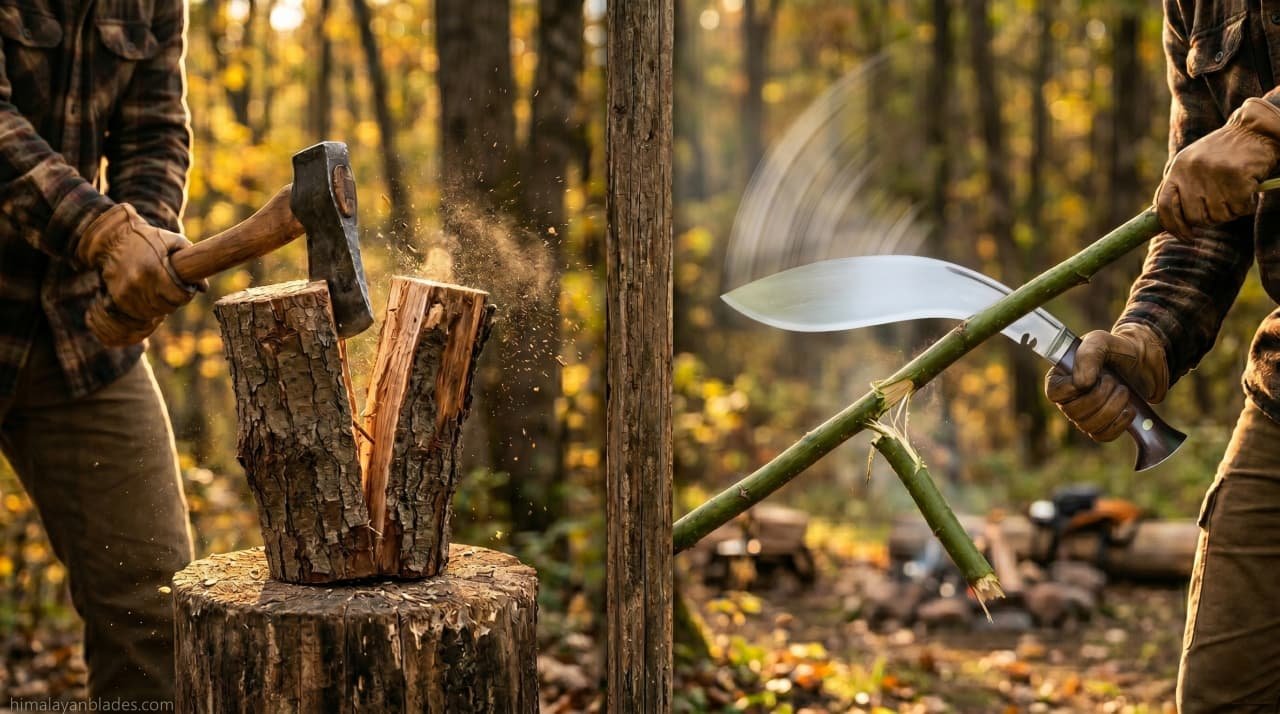
This is where the hatchet truly excels, and we won’t pretend otherwise. Because of its wedge shape, it splits logs and frees itself effortlessly with each strike.
Kukris, however, have a much thinner profile. Because of this, they also bite in, and, of course, stick. To complete the split, you can baton the kukri spine with another piece of wood.
While this is effective, it is also much slower than a hatchet that is designed for splitting. Consider it a free upper-body workout you never signed up for.
Kukri vs Hatchet Axe: Carving and Precision
In terms of carving and elegance, the Kukri gets the point. When carving tent pegs, feather sticks, or even flattening bark, you can use the Kukri like a draw knife or, with a choke-up grip, like a carving knife. It has about 80 to 85 percent of the effectiveness of a carving knife.
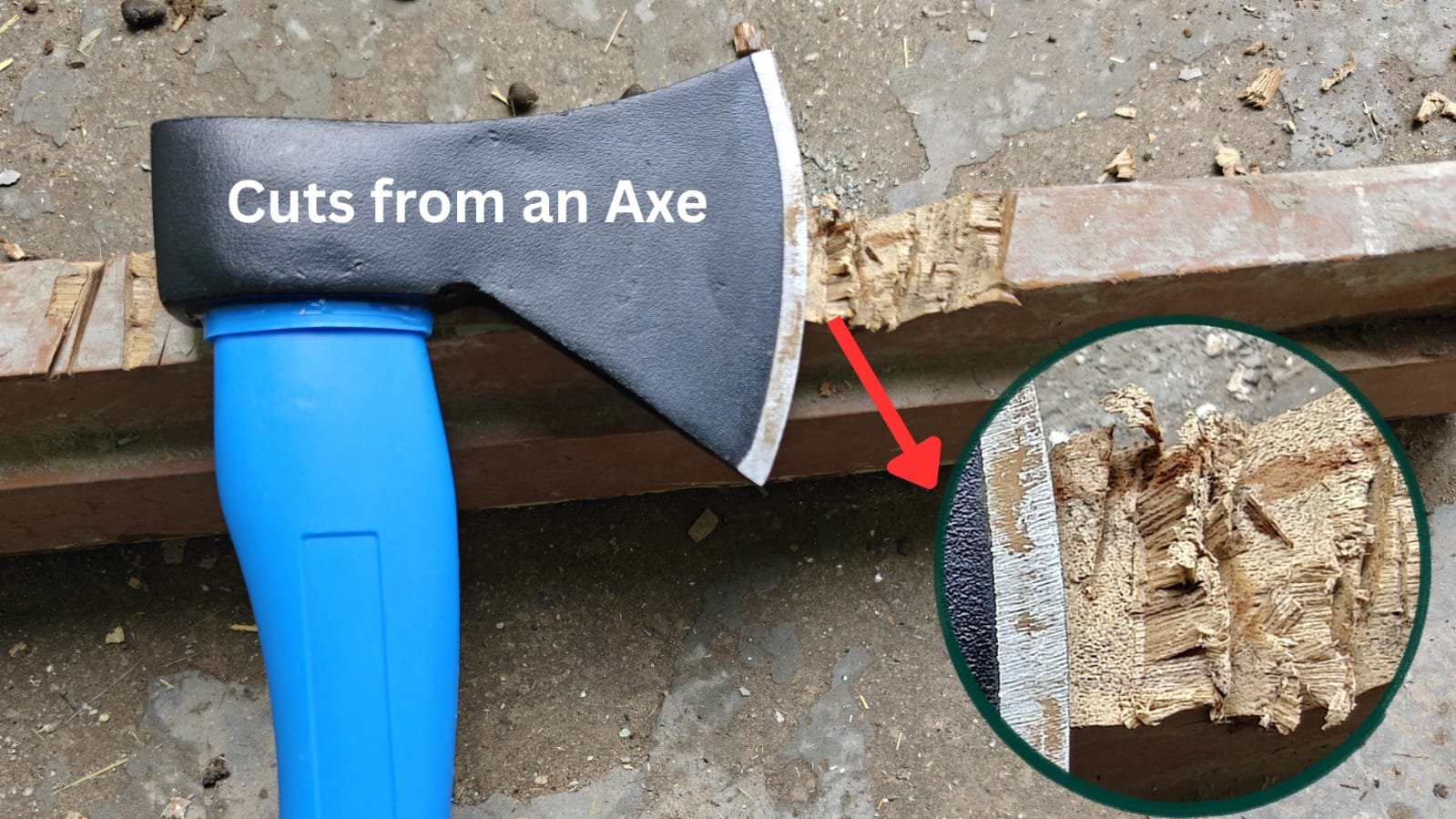
I made feather sticks with axe and kukri, the result showed that the kukri had made very beautiful and thin feather sticks due to its thinner edge in comparison to kukri and axe had made thicker feather sticks and uneven. The photos are shown below for reference.
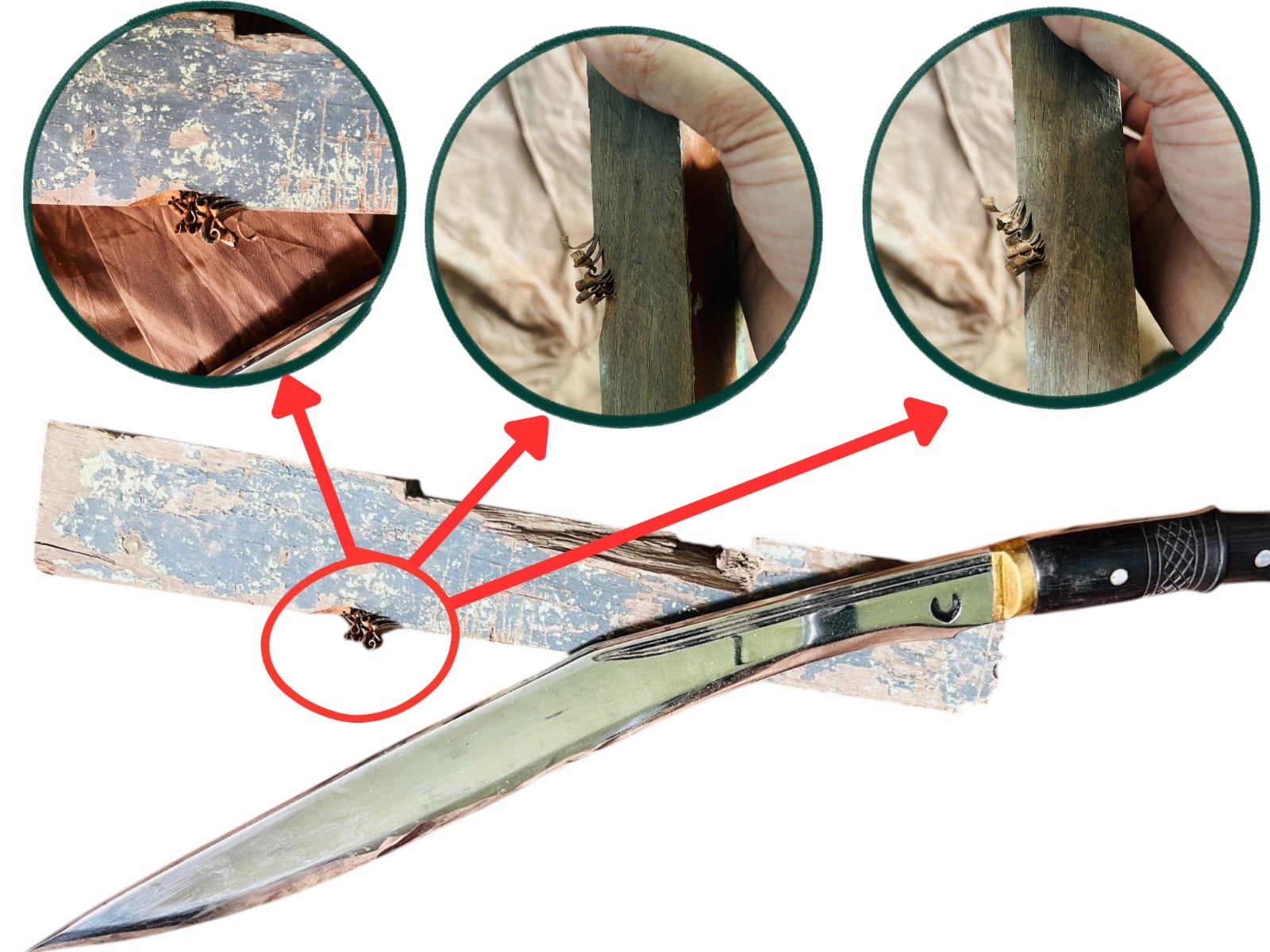
A hatchet can also be used for carving. However, the results come a lot slower with a higher amount of frustration. When it comes to carving, the kukri is also a clear winner.
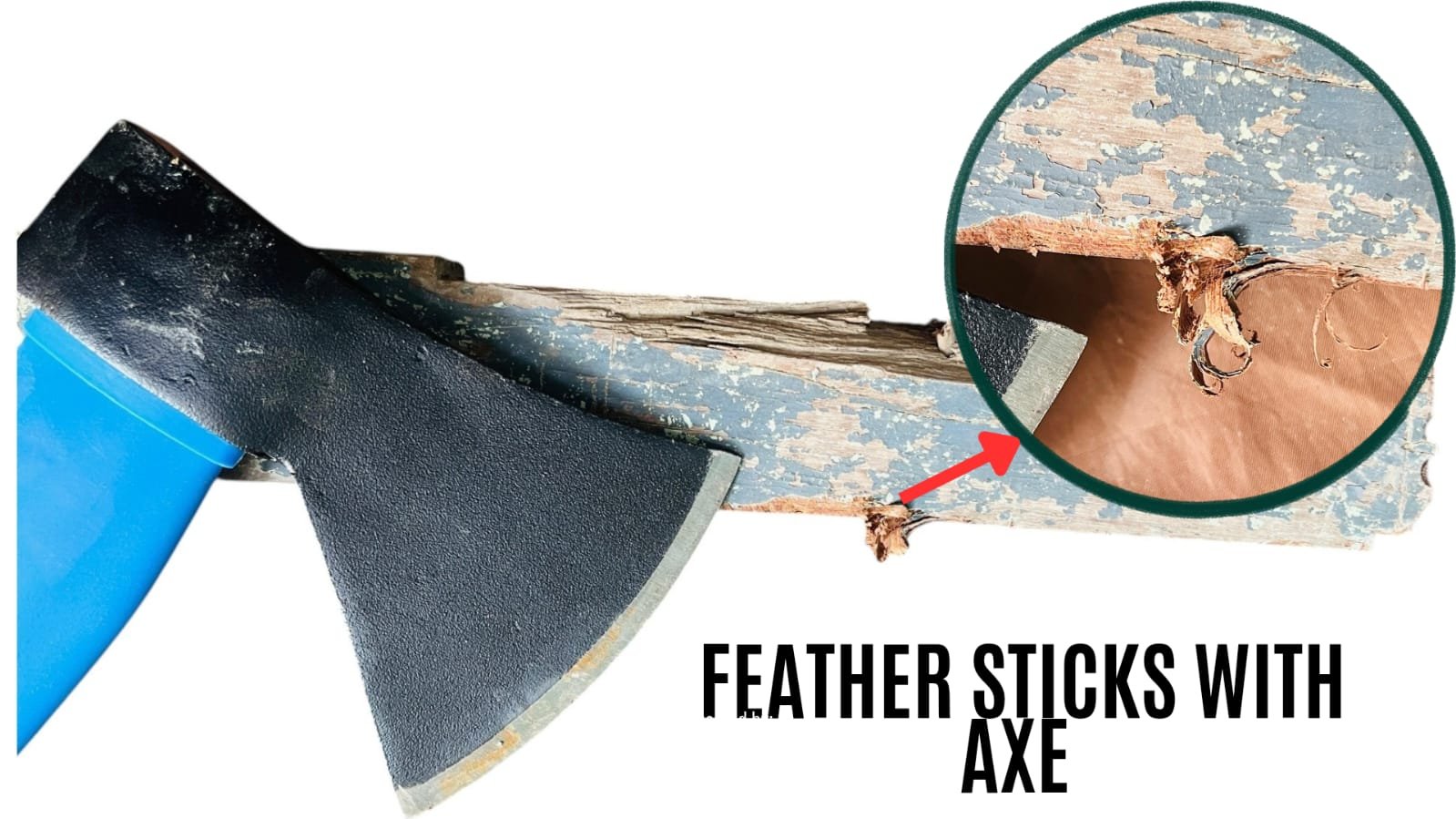
My results show that the axe are not very effective in carving other things and are not as versetile as kukri however the axes are superios in splitting the wood, due to their thicker edges that carving is not very effective.
Kukri vs Hatchet Axe: Food, Game, and Defense
In this category, the Kukri is the clear winner. The blade profile of the Kukri has all the characteristics of a culinary blade when it comes to cooking and preparing food, and dealing with game. Conversely, the hatchet leaves a bloody mess when attempting to gut or fillet a fish.
The hatchet pounds stakes, and if you turn it over, the flat poll drives stakes. A kukri is unable to do this.
The Kukri wins the self-defense category. Because this blade is from Nepal, it is intended for self-defense and combat. A hatchet is difficult to wield but is also very heavy.
Kukri vs Hatchet Axe: Weight, Calories, and Carry
It becomes clear how important an item’s weight is, once you have walked a few miles bearing their burden. A traditional kukri weighs between 450 and 650 grams.
Most people find their mid-weight kukri to be relatively light since the center of mass is positioned a few inches in front of the handle. The blade of a kukri swings with a lot of momentum and is very difficult to stop.
Very few models of heavy-duty kukris break the limit of 2 lbs, and in general, most field blades are lighter than that.
A hatchet’s head carries its mass at the very end, making its geometry very impactful. This heavier design costs you more energy. After a long day of use, the design will leave your shoulders sore and fatigued.
The kukri also has the advantage of easier carry. A hatchet and a knife combined weigh 30 to 42 ounces. A kukri alone weighs 18 to 24 ounces and is capable of performing most of the same tasks. Because of this advantage, you can lose almost a pound of weight from your pack and avoid frequent swaps of tools during use.
Kukri vs Hatchet Axe: Shock and Ergonomics
It is important to be honest with ourselves. When it comes to long chopping sessions, the design of a hatchet soaks up impact shock making it easier on your joints. On the other hand, kukris send shock and vibrations to your joints. This is fatiguing because of its impact over longer sessions.
The handle of a kukri also becomes slippery and very thick during impact, but it can be improved with a fitted handle. In the case that either handle fails in the field, you can replace the hatchet handle by carving a branch for a new handle, or wrapping your full-tang kukri with paracord.
Kukri vs Hatchet Axe: The Verdict
It depends on your kit. If you have tools, a folding saw, a pocket knife and a belt knife, then a hatchet is good to fill in your kit to do wood splitting. In a full kit, a kukri becomes redundant.
If you are taking a trip with one knife to a minimalist kit, or going on a backpacking trip, then a kukri is good for the job. It is good for 85 to 90 percent of the job of a knife and a hatchet, and does this at around 60 percent of the weight of the two combined. The kukri is good for preparing food, cutting animals, carving, and defense.
Kukri vs Hatchet Axe: FAQ
Can a kukri split wood like a hatchet?
No. A hatchet can split wood better because of its shape. A kukri can cut and chop better, but if you are going to split wood, then you can baton which is easier. A hatchet is better if you are going to cut wood for a fire.
Does a kukri do the job of a knife and a hatchet?
Pretty much. A kukri can do almost 90 percent of a hatchet and knife and does this at 60 percent of the weight of the two combined. For minimalist trips, it can do the job of the two, but a proper hatchet is still needed for heavy wood splitting.
Why does a kukri have the ability to do a lot of chopping and cutting despite its weight?
A kukri weighs a lot, because it is designed to chop really well, but the balance is a few inches in front of the handle.
Purchase a Kukri Forged in Nepal
Your only choice to tackle wilderness tasks is the one-tool wilderness work. A forged 5160 kukri will chop, carve, cut, and slice while providing a defensive tool all in one blade. Every kukri comes with its specs, evidence of the process of its creation, and a way to contact the creator.
Every price you see have a markup from a distributor. The price is based only on the quality of the steel used and the skill of the craftsman. Do check out our kukri vs machete article.
Our Product Suggestions
These are one of the best selling kukri knives here:
Best selling products
-
Tin Chira Khukuri
$195.00 -
Neo Hanshee Kukri
$120.00 -
MK2 Khukuri
$135.00 -
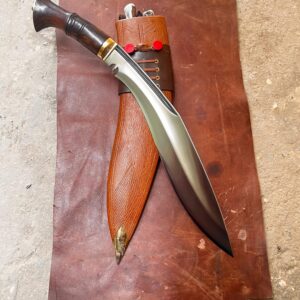
Fast Angkhola Khukri
$145.00 -
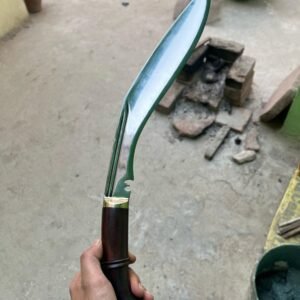
6th GR War Serupate Kukri
$135.00
Research Sources
This comparison combines first-hand testing at Himalayan Blades Nepal with field-test findings compiled from independent bushcraft and survival video reviews. We took the bevel-angle and weight measurements directly from the Kukri at Himalayan Blades. Kukri testing took place in the Himalayan region of Nepal and spanned a duration of three months. The test focused on Kukri’s ability to chop, split, carve, and process wood.
- Himalayan Blades Kukri testing (2026)
- Independent bushcraft and survival video reviews
- Kukri – en.wikipedia.org/wiki/Kukri